
Beyond “Layers”: The Thermal Regulation Protocol

What Layering Actually Does
You want to believe that buying the right gear solves the problem. It doesn’t. Layering isn’t about stacking clothes—it’s about managing moisture and airflow, two variables that older adults control poorly in winter conditions. Thermoregulation operates on the same principle as any system: input, processing, output. Your body generates heat. Clothing traps it. Sweat breaks the system. The real mechanism nobody states plainly is that most older hikers overheat during exertion, sweat into their layers, then freeze hard when they stop moving. That’s the trap.
The standard advice to “wear moisture-wicking base layers, insulating midlayers, and a windproof outer shell” is incomplete. It assumes you’ll execute the system perfectly in real conditions. You won’t. Older adults have slower metabolic rates and lower sweat response, which actually works in your favor—but it also means you’ll underdress, thinking you’ll warm up on the move. Then midway through the hike, when exertion stabilizes, the cold hits differently. You need to front-load the outfit decision before you start, not adjust it mid-hike like a younger person would.
Temperature Matching Beats Generic Layering

Forget the “three-layer system” framework. Build your outfit around the specific temperature you’ll experience in the first 20 minutes, not your expected body temperature later. For older adults hiking in winter, your metabolic heat output stays lower and more stable than younger hikers. This means you can’t rely on movement to warm you up faster. A 65-year-old on a winter trail generates roughly the same calories per mile as that same person would on flat ground—no acceleration expected.
The protocol: Start with a thin merino wool or synthetic base layer only if the temperature is below 25 degrees Fahrenheit. Add a fleece midlayer if it’s below 15 degrees. Add a down or synthetic insulation layer if it’s below 5 degrees. Do not overthink fit or brand. What matters is that each layer breathes and dries quickly if you do sweat. Wear your insulation jacket the entire hike—don’t pack it. Stop before you get cold, not after.

The Unseen Danger: Moisture Management For Winter Mode

Sweat’s Silent Kill: Fabrics To Avoid
You’re worried you’ll overheat and look foolish, so you’ll underdress. That fear kills older adults in winter more reliably than cold does. Here’s the mechanism: your body generates heat during exertion. Cotton absorbs that sweat and holds it against your skin. When you stop moving, evaporative cooling accelerates heat loss faster than your aging thermoregulation can compensate. Hypothermia sets in quietly.
Cotton, wool blends below 80 percent wool, and most “breathable” synthetics with poor wicking capability all trap moisture in the fiber matrix. The fibers swell when wet, blocking the capillary channels that move moisture outward. You need fabrics that move sweat away from skin to the outer layer where air can evaporate it. Merino wool above 80 percent, polyester, and nylon accomplish this. Avoid anything marketed as “soft” or “cozy” if the fiber content doesn’t specify moisture management properties.
Wicking And Ventilation Essentials
Thermodynamics governs this layer system, not preference. Your base layer must move sweat faster than your body produces it during the hike. Merino wool regulates temperature better than synthetics because it absorbs up to 35 percent of its weight in moisture without feeling wet or losing insulation value. Synthetic polyester and nylon wick faster but don’t retain warmth when damp. The protocol is simple: base layer of merino wool or high-quality synthetic, mid-layer of fleece or down for insulation, outer shell that blocks wind and sheds water without trapping vapor.
Ventilation points matter more than you think. Open your jacket collar or pit zips within the first ten minutes of hiking, before sweat accumulates. Most older adults wait too long. Close these vents gradually as your pace slows and your body heat drops. Your outer shell should have underarm zips or pit vents that open independently of the main zipper. This prevents the accordion effect where you’re either too hot or too cold with no middle ground. Vent early and often—this is where most winter hiking failures happen.
Footwear As Foundation: Waterproof Hiking Boots Decoded
What Waterproof Actually Means
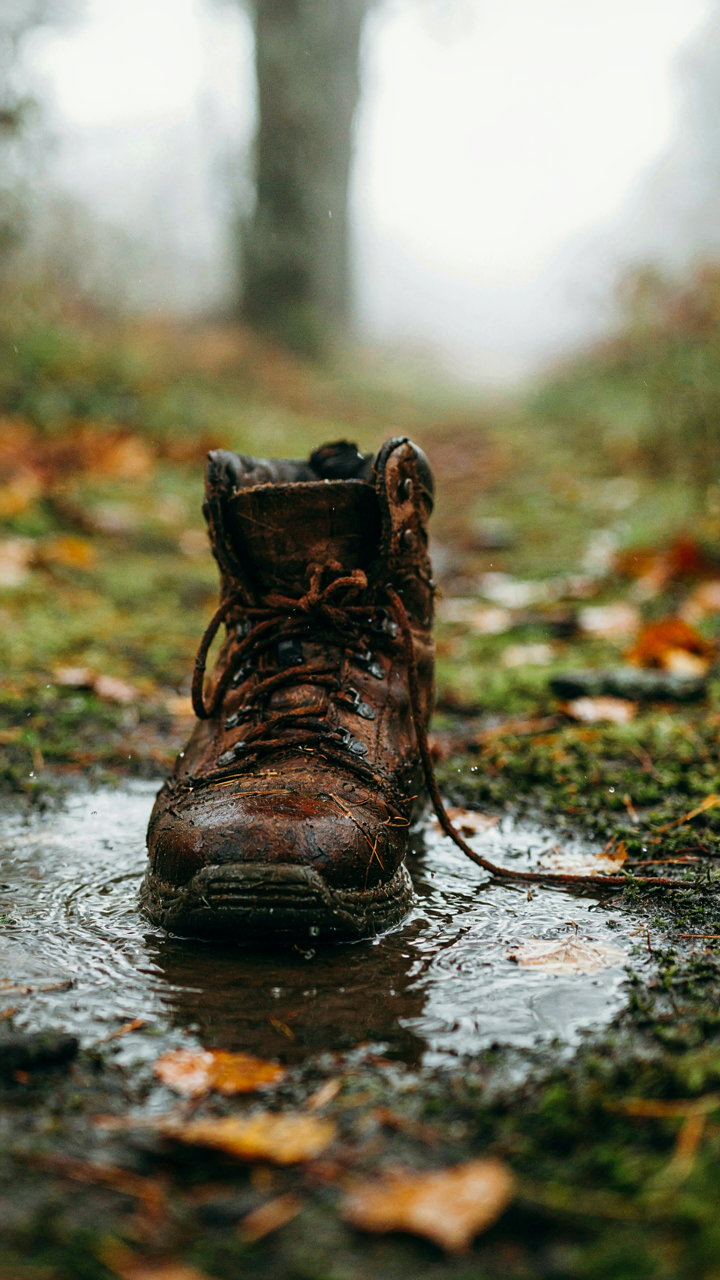
You want to believe the label because admitting boots fail in wet conditions means you picked wrong. Here’s the mechanism: “waterproof” on boots is a marketing term with no legal definition. Most hiking boots use breathable membranes like Gore-Tex that block liquid water but let vapor pass through. This works until the membrane saturates or water enters through the collar, seams, or laces. After two to four hours in wet snow or stream crossings, your feet get wet regardless of the label claim.
The real divide is between treated leather and synthetic uppers, both of which will eventually leak. Treated leather breathes better but absorbs moisture slower. Synthetics dry faster but trap sweat inside the boot. Neither achieves true waterproofing in winter conditions. What matters is how fast water enters and how quickly you dry out afterward. Choose boots rated for the specific terrain and duration you’ll actually hike, not the marketing promise on the box.
Traction, Insulation, And Fit Under Load
Winter hiking demands a biomechanics frame: your foot under load on ice is a friction problem. Most older adults lose proprioception with age, meaning your ankle stability and balance decline. A stiff sole with aggressive tread and high ankle support compensates for this deficit. Vibram or similar rubber compounds with deep lugs grip frozen surfaces better than smooth soles. The boot must support your foot as it shifts on uneven terrain, not just keep it warm.
Insulation thickness matters more than material type. Thinsulate or PrimaLoft rated to 200 grams works for mild winter hikes under three hours. Drop to 400 grams for full-day outings in sustained cold below freezing. Fit is where most hikers sabotage themselves: boots sized for thick socks in a store feel loose on the trail. Your toes need one finger’s width of space from the boot toe when standing. Lace boots tight enough to lock your heel in place during descents, or your foot slides forward and compresses toes, cutting off circulation.
Mobility Over Bulk: The Adventure Outfit Advantage
Why Heavy Gear Fails Older Hikers
You want to feel equipped and safe on the trail. That’s not weakness—it’s survival instinct. But heavy gear creates the opposite effect. Physics determines this: mass increases the energy cost of every movement. Your legs, joints, and cardiovascular system pay the penalty on every step. A ten-pound pack isn’t just ten pounds heavier. It compounds fatigue, destabilizes your gait, and forces compensation patterns that stress knees and hips.
The common advice says “bring layers.” That’s incomplete. The real problem is layering wrong—stacking materials that trap weight without function. Merino wool and synthetic base layers provide insulation at ounces, not pounds. Down jackets compress small. Fleece adds bulk without warmth. Most older hikers oversized their winter outfits decades ago and never recalibrated. The outfit that worked at fifty doesn’t work at seventy. Your aerobic capacity changed. Your recovery window shortened. Your tolerance for wasted load evaporated.
Unrestricted Movement: Fabric Choice
Unrestricted movement demands fabric that moves with your body, not against it. Synthetic materials dominate winter hiking because they manage moisture while maintaining mobility. Nylon and polyester stretch, compress, and shed water without absorbing it—critical for older adults whose thermoregulation isn’t as responsive as it once was. Cotton has no place here; it traps sweat and adds weight when wet. Merino wool excels as a base layer because it regulates temperature across a wider range than synthetics alone.
The mechanism is simple: fabrics with built-in stretch reduce the muscular effort needed to move. Tight or stiff materials force your body to work harder during each stride. Over six miles, this compounds into exhaustion. Your hip flexors, knees, and ankles stay fresher when the garment cooperates with your natural range of motion. Tight zippers, restrictive waistbands, and reinforced seams all work against you on the trail. Choose fitted but loose-enough pieces. Test mobility before you buy—raise your arms overhead, squat, step up on a bench. If the garment restricts you in the store, it will betray you on the mountain.
The Urban Myth Of “Comfy Shoes” On Ice
Why Your Current Shoes Will Betray You
You want to believe your hiking boots will grip ice the same way they grip dirt, because replacing them feels wasteful. Here’s the mechanism: ice is a lubricant, not a surface. Your boot sole needs microscopic texture or active edge engagement to cut through that film of molecular water that forms between rubber and frozen ground. Smooth rubber on ice has almost nothing to grip.
Physics calls this coefficient of friction, and winter hiking outfit older adults need to understand it the way a driver understands tire traction. Most hiking boots ship with tread patterns designed for soil and rock. That same tread becomes nearly useless below 32 degrees on ice. The lugs flatten out, and you’re essentially walking on a hockey puck with feet.
Traction Tools That Actually Work
Skip the generic advice about “good winter boots.” You need mechanical intervention. Ice demands active grip systems, not better tread patterns.
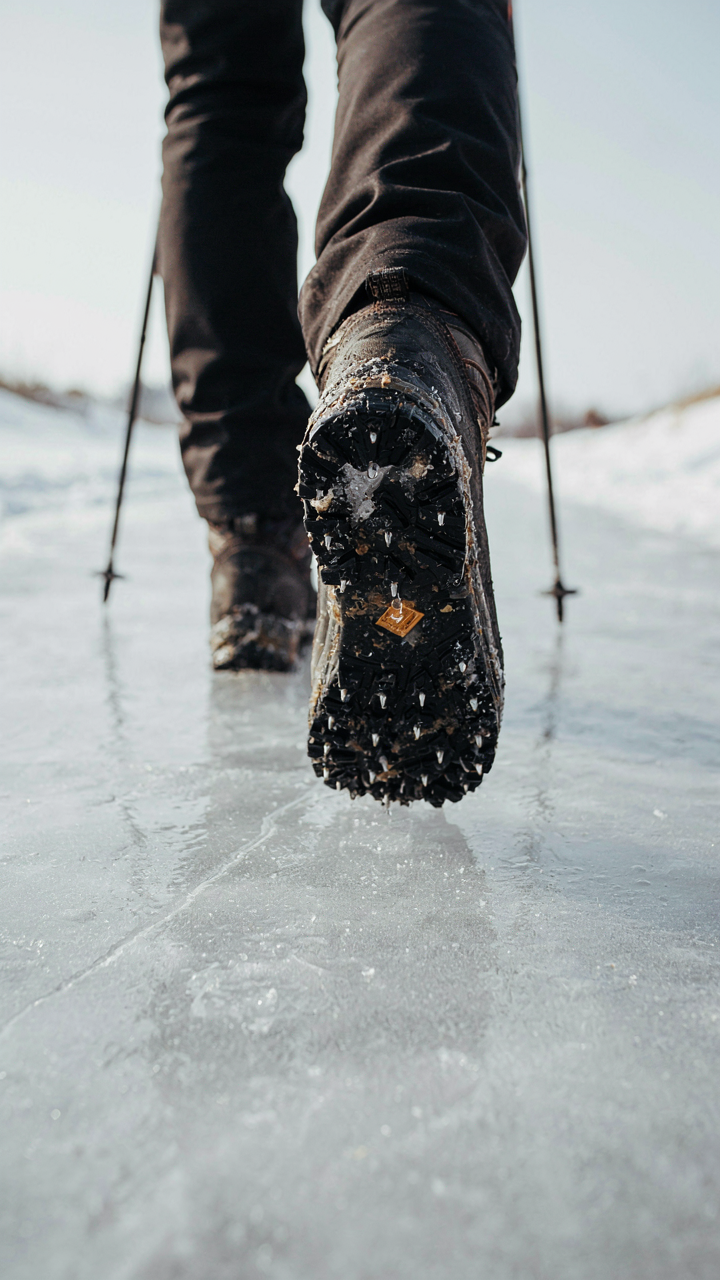
- Microspikes: Steel points penetrate ice directly. Strap them over your existing boots. They work immediately and require zero boot investment. Most hikers over 60 use these for steep or icy sections.
- Yaktrax or similar chains: Rubber harnesses with metal teeth. Lighter than microspikes, easier to pack, work on mixed terrain. Trade-off is they slip on very hard ice compared to spikes.
- Crampons: Aggressive 10-point systems for serious alpine ice. Overkill for most winter hiking older adults do. Use these only if you’re on glaciated terrain or steep ice routines.
- Gaiters: Seal the gap between boot and pant leg. Prevent snow from entering your boot. Neoprene or Gore-Tex options work. Essential if you’re post-holing through deep snow.
- Insulated boot covers: Slip over regular boots for thermal protection. Useful for stationary observation or lighter snow walking. Don’t rely on these for serious traction needs.
The real protocol: attach traction aids before you hit ice, not after your first slip. Your body doesn’t recover from a fall the way it did at 30. Microspikes weigh less than a pound and transform an uncertain walk into a stable one.
The “Tailored Trousers” Fallacy: True Leg Protection
Beyond Fashion: Practical Legwear
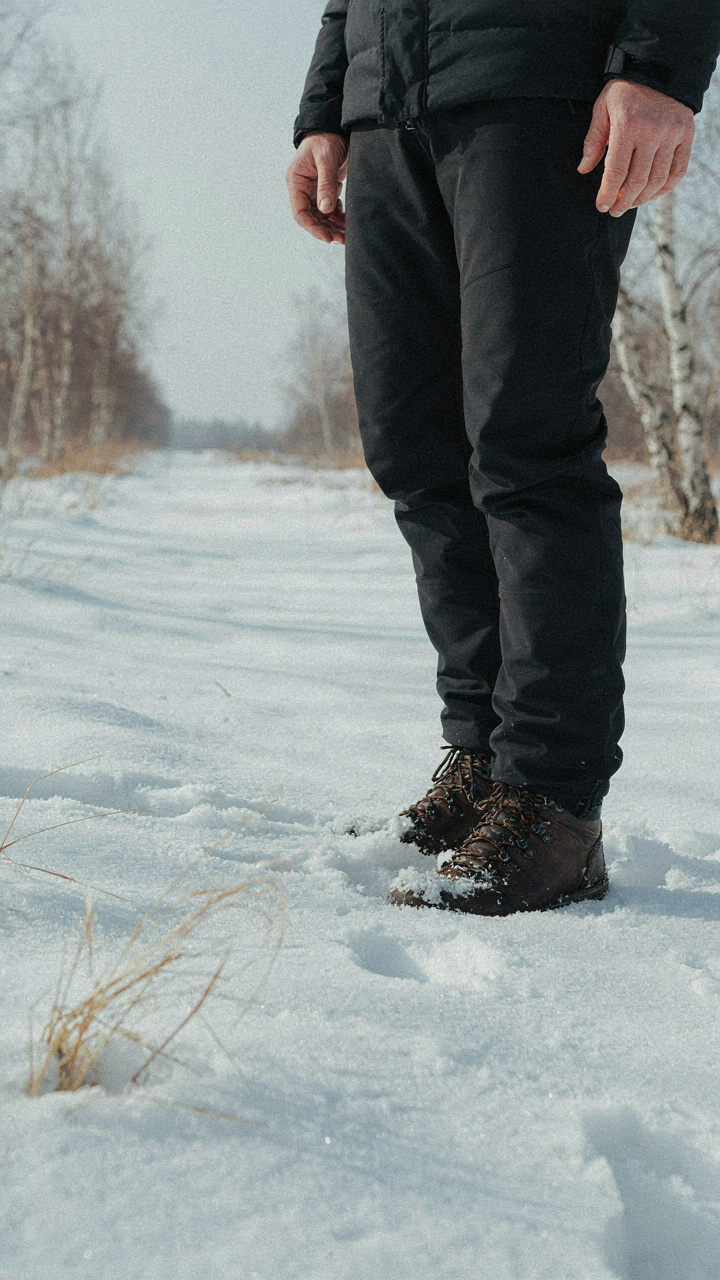
You want to look like you belong on the trail, not like you’re escaping a nursing home. That’s the real reason most older adults overthink leg coverage. The mechanism is simpler: your legs lose heat faster than your core because they have less muscle mass and more surface area, so the goal isn’t style—it’s a barrier system that moves with you without restricting your hips and knees.
Most hiking advice treats legs like an afterthought and pushes generic “moisture-wicking” pants that fail in real conditions. What works instead is layering intention: a base layer that stays dry, an insulating middle layer that compresses without bunching at the joints, and an outer shell that blocks wind and water. The base layer should be synthetic or merino wool—never cotton, which traps sweat and kills you slowly in cold. Your middle layer handles most of the insulation work, so it needs to be chosen for compressibility, not thickness.
Wind, Water, And Abrasion Resistance
Borrow from materials science here: a material’s resistance to penetration depends on fiber density and weave tightness, not thickness. Your outer shell pants need a tight weave that stops wind before it reaches your insulation, and a durable water-repellent coating that sheds moisture without making you a plastic bag. Most older adults buy shells that are too heavy, too restrictive, or both—a consequence of confusing “durable” with “stiff.”
The real test is function at the joints. Sit in a deep squat. Can you still grip the ground with your boots? Can you rotate your hips without the waistband digging? If the answer is no, the pants are too tight or too rigid. Seams matter more than you think: taped seams on the thighs and calves stop wind channeling. Gaiters seal the ankle gap where wind and snow enter. This is the protocol: base layer on, insulation layer on, shell pants on, gaiters over the boots. Without this sequence, you’re hiking half-protected.
Utility Jacket: Not Just A Shell, An Ecosystem

Your Microclimate Control System
You want the jacket to do the thinking for you. That’s the real ask. But here’s what people miss: the jacket doesn’t trap heat. It manages air movement and moisture. Think of thermodynamics—specifically convection. Your body radiates warmth, and wind strips it away. The jacket’s job is to block convection while letting sweat escape. Most jackets fail because they’re designed for youth metabolics, not the reality of how older bodies regulate temperature at lower exertion levels.
A utility jacket for winter hiking needs a soft-shell or hybrid design. Hard shells trap moisture against your skin. Soft shells breathe. They’re flexible enough to layer without bulk, and they shed light snow without the sweat penalty. The fabric needs a DWR coating (durable water repellent) that actually works—not marketing speak. Older adults generate less metabolic heat during sustained activity, so the jacket becomes your thermostat, not your backup. Choose one that weighs under two pounds and compresses to fist-size.
Ventilation Placement And Pocket Logic
Everyone talks about pockets. Nobody explains why they matter in winter. Pockets aren’t storage. They’re heat management. Your hands generate significant warmth when moving. On a winter hike, your hands need a place to go when your core starts overheating from exertion but your extremities are still cold. This is the pocket strategy: positioned high on the ribs, not the lower torso.
The jacket needs pit zips or underarm ventilation vents. These aren’t luxury features. They’re critical escape valves. When you’re climbing elevation and your internal temperature spikes, you need to dump heat without removing layers. Without vents, you sweat into your base layer, then cool too fast during descents. Hand pockets should be angled slightly upward and deep enough to accommodate gloved hands. Chest pockets add nothing functional in winter. Place your pockets for thermoregulation, not fashion, and you eliminate the stop-and-strip cycle that exhausts older hikers.
The Nature Outfits Paradox: Blending In Vs. Standing Out
Why Visibility Matters More Than Camouflage
You want to look like you belong out there. That desire is real, but it’s working against your survival math. Search and rescue operates on a physics principle: contrast detection. Your brain doesn’t find objects that match their surroundings. It finds edges, discontinuity, things that break the pattern. A hiker wearing muted earth tones against brown rock and grey snow becomes invisible to the human eye scanning a landscape. Rescue teams spot movement and color anomalies first, distance second.
The outfit logic most older adults hear is backwards. Blend in, stay natural, respect the wilderness aesthetic. That advice gets people lost longer. Modern SAR teams trained in visual sweep patterns confirm that high-contrast clothing reduces search time by hours, sometimes the difference between hypothermia and a safe extraction. Your outfit’s job isn’t to match nature. It’s to rupture the visual field so someone scanning a ravine or ridge sees you immediately, not eventually.
High Contrast Signals Work Like System Design
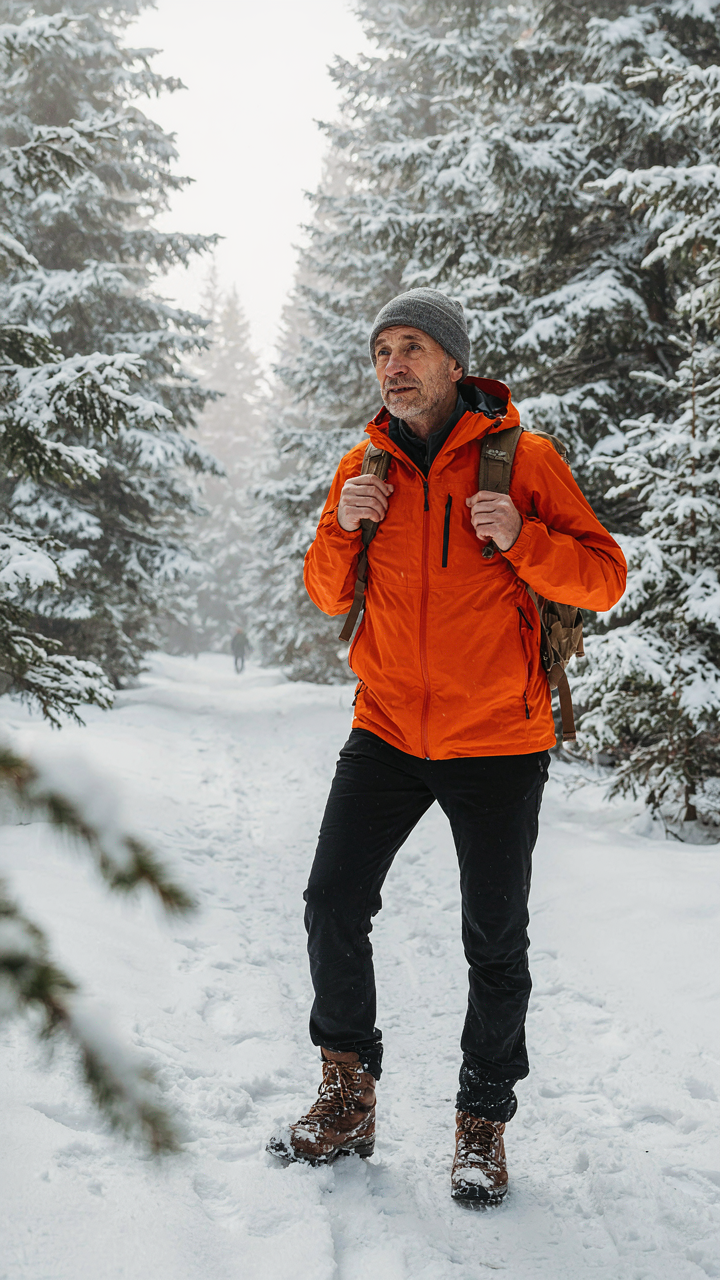
Emergency signals operate on one rule: exploit the asymmetry between background and object. Neon orange, hot pink, electric yellow, and international orange all work because they don’t exist in winter landscapes. Your jacket should announce itself. The color stops being about fashion or preference. It becomes a communication layer between you and potential rescuers.
Pair your high-contrast outer layer with a second signaling system. A bright beanie, a reflective backpack, or a GPS communicator adds redundancy to your visibility. Older adults hiking in groups should coordinate at least one person in unmissable color per party. Single hikers make the visibility calculation non-negotiable. The mechanism is simple: maximum contrast during daylight, reflective materials for low-light scenarios, and a color palette that forces detection rather than demands it.
Winter Hiking Outfit Women: Specific Considerations, Not Concessions
Performance Fit Solves The Real Problem
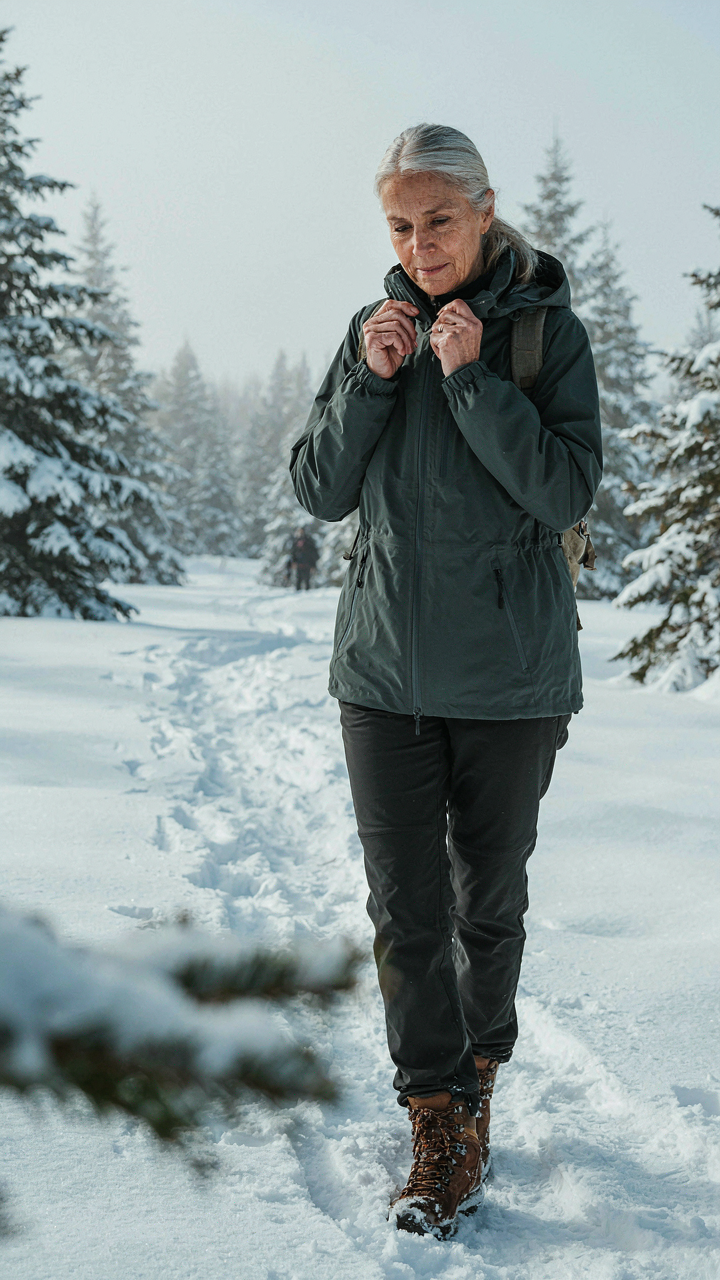
You’re reading this section because you don’t want to look like you’re trying too hard or admit that standard men’s sizing fails you. Here’s the mechanism: women’s bodies distribute muscle and fat differently than men’s. Your shoulders sit narrower, your torso shorter, your limbs proportionally longer. Gear designed for male frames creates dead space—pockets that miss your hips, sleeves that bunch, waistbands that gap. Dead space kills thermal regulation because air moves through it.
Most winter gear makers treat women’s cuts as a cosmetic downsize. They shrink everything equally. That’s lazy and wrong. Performance fit means proportional adjustments to core placement, arm length, and torso rise. Your jacket should sit at your actual hip, not hover two inches below it. Your gloves should account for smaller hand volume but longer fingers relative to palm width. Test fit in layers, not bare skin. If you raise your arm overhead and the hem pulls out of your pants, the jacket doesn’t fit your proportions, regardless of the size tag.
Thermoregulation Works Differently Than Men’s
Thermal biology matters here, so call it what it is: women’s bodies have lower baseline metabolic rates and higher surface area relative to mass. Translation from physiology to hiking—you generate heat slower on cold hikes, lose it faster through exposed skin, and can’t rely on exertion alone to stay warm. The common advice about layering applies equally to everyone. It doesn’t. You need a base layer that traps warmth at lower activity levels. Men typically warm up quickly during sustained effort; you stabilize at a lower temperature, especially if perimenopause has already shifted your thermostat.
Estrogen and progesterone fluctuations also affect how your body handles temperature stress across the month. You’re not imagining it if you feel colder mid-cycle. Build your system for your coldest week, not your average week. This means your insulation layer should be thicker than a man’s of equal fitness would need, and your wind layer should seal better. Start the hike slightly underdressed by male standards—you’ll reach your thermal steady state before mile two, not after.
Gloves And Hats: The Extremity Neglect Protocol

Where Heat Actually Leaves Your Body
You skip the gloves because you think toughness matters. It doesn’t. Physics does. Convection and conduction remove heat faster from exposed skin than from any other body part. Your head and hands represent roughly 10 percent of skin surface but lose heat disproportionately because blood vessels near the surface constrict last during cold exposure. Your core survives longer than your extremities. The mechanism is simple: wind moves heat away from skin (convection), and direct contact with cold materials pulls heat out (conduction). Both happen immediately on uncovered hands and an exposed scalp.
Older adults face a compounded problem. Thermoregulation deteriorates with age. Your body takes longer to recognize cold and slower to respond. A 70-year-old hiker loses heat from extremities faster than their body signals the threat. Lightweight gloves or a thin beanie won’t cut it. You need deliberate layering in those zones. The real mistake isn’t choosing between gloves and hand warmers, it’s treating extremity protection as optional or secondary. It’s the first defense against the trail ending early.
Strategic Hand And Head Protection
Gloves solve a specific problem: windchill on exposed skin. The common advice says “bring mittens for warmth and gloves for dexterity.” That’s incomplete. Mittens trap dead air around all five fingers at once, which works. Gloves force air between each digit, which fails in sustained cold. For older adults on winter trails, mittens with a removable or flip-back liner give you both insulation and access to gear without removing protection entirely. Keep them on until you reach trailhead or emergency shelter.
Hats matter more than coat insulation on a winter hike. A wool or synthetic beanie covering your ears and back of neck prevents convective loss from the scalp and blocks wind from reaching the carotid arteries in your neck. Avoid cotton. It absorbs moisture and loses all insulation when wet. Choose merino wool or acrylic blends instead. The protocol: put your hat on before you feel cold, not after. Once shivering starts, your core is already prioritizing survival over comfort. You’re already behind. Gloves go on at the same moment, before the first descent where wind accelerates.
The Real Obstacle Isn’t The Cold, But Your Outdated Reliance On Comfort Over Capability
You’ve spent decades choosing comfort. Soft couches. Climate control. The path of least resistance. Winter hiking demands the opposite. Stop buying gear that feels good sitting down. Start buying gear that performs when your body fights the mountain. Take yesterday’s outfit and replace one item with something built for function, not lounging. The difference between a hike that happens and a hike that never starts is one decision made today, not tomorrow.