

Beyond The Brochure: Why “Beginner” Boards Hide Your Adrenaline Potential

Beginner Boards Work Everywhere, Not Just Flat Water
You’re worried a beginner board signals weakness. It doesn’t. The real mechanism here is flotation math: beginner boards carry more volume, which means they float higher in the water and require less paddle force to stay upright. That same physics works on small waves, chop, and moving water just as well as it works on lakes. The brochure lie is that volume equals limitation. It doesn’t.
Beginner boards launched the modern SUP movement because they solved a real problem: they let people stand up without falling constantly. But that same stability transfers to dynamic conditions. A 10-foot, 32-inch-wide beginner board with 120 liters of volume floats the same in moving water as it does in flat conditions. The board doesn’t care where it is. You do, because you’re still learning edge control and weight distribution. The board gives you the margin to experiment without drowning.
Stability Versus Engagement: The Real Trade Off

Stability is not the opposite of engagement in physics terms, it’s the prerequisite for it. In control systems engineering, a stable platform is the foundation that lets you make deliberate inputs without the system fighting you back. A beginner board’s extra width and volume create that stable platform. Then, once you’re actually standing without panic, you can begin loading the rails, practicing weight shifts, and feeling how the board responds to your intention.
The common advice says beginners should stay on stable boards until they’re “ready” for performance. That’s incomplete. What actually matters is learning to engage the board consciously before you move to a narrower platform. Beginner boards aren’t training wheels you abandon. They’re the machine where you build the neurological patterns your body needs. Once those patterns exist, you switch to a narrower board and suddenly have precision because you already know how to create pressure through your feet. Start engagement practice now, not later.

The Kinetic Control Method: How To Paddle Board For Max Thrill

Where Your Feet Live On The Board
You want to feel in control because feeling out of control is terrifying, and terrified people don’t come back. The mechanism is simple: your feet position determines your board’s pivot point. Stand too far back and the nose lifts uselessly. Stand too far forward and you lose maneuverability. Most beginner advice says “stand in the middle,” which is incomplete. The real answer: stand with feet shoulder-width apart, centered between the board’s edges, not its length. This position lets the board respond to your weight shifts without lag.
Your weight distribution controls edge pressure, which controls turn speed and sharpness. Lean slightly forward to engage the board’s planning surface and generate glide. Shift your weight to one side and the opposite edge catches water, creating immediate directional change. This responsiveness is what separates a dead plank from a tool. Practice weight shifts on flat water first. Once your body knows where neutral is, transitions to maneuvers happen without thought. The drill: stand still for thirty seconds, then shift weight side to side in one-second intervals until micro-adjustments feel automatic.
Paddle Mechanics: Force Through The Lever
Physics uses the term “mechanical advantage” to describe how leverage multiplies force with minimal effort. Your paddle is a first-class lever. The fulcrum is the water. Power comes from your core, not your arms, and beginners waste energy by reversing this. Efficient paddlers lock their core and use their torso rotation to drive the blade through water. Arms stay relatively straight and act as transmission cables, not engines. The blade catches water at your hip and exits near your back foot. This arc generates maximum power transfer per stroke.
Quick maneuvers demand paddle speed, not strength. Shorten your stroke and increase tempo instead of muscling harder. A fast, controlled stroke plants the blade deep and pulls it straight. This creates predictable board response and lets you compound turns. Sloppy strokes with excessive arm movement waste energy and destabilize the platform. Set a baseline: twenty strokes per minute at steady pace on flat water, focusing on blade entry and exit quality. Once that feels grooved, increase tempo by five strokes per minute every session until thirty strokes per minute becomes your normal cruising speed.
Unlocking The SUP Paddle: Your Command Center, Not Just An Oar
Length And Grip: The Feedback Loop
You want to feel like you know what you’re doing the moment you push off. That’s the real reason this matters. But here’s what nobody says plainly: paddle length is a signal transmission system. In mechanical engineering, signal fidelity means how clearly information travels from source to receiver. Your paddle transmits water feedback directly through your hands. Get the length wrong and you lose that signal entirely, turning the blade into dead weight instead of a sensor.
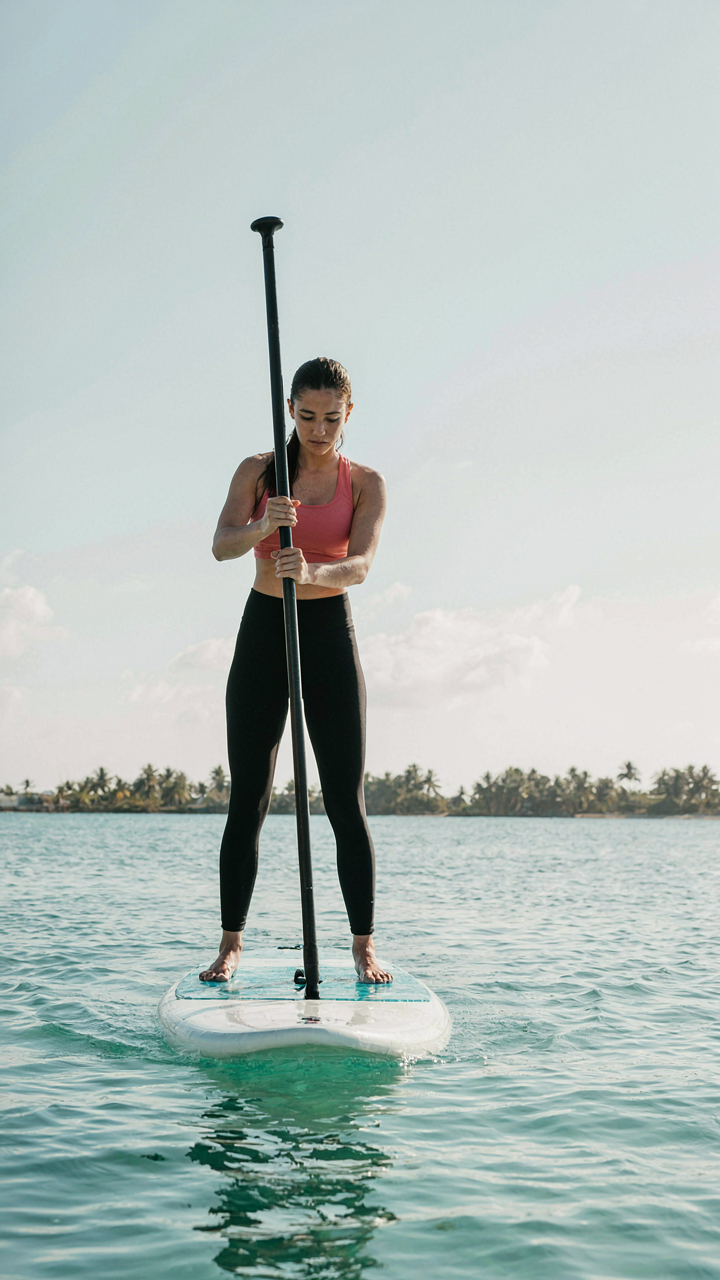
Paddle length should reach 8 to 10 inches above your head when standing flat. Most beginners choose too short, trading reach for false control. A properly sized paddle lets you catch more water per stroke with less effort, which means your arms stay fresh longer and you maintain balance through better leverage. Grip width matters equally: hands should sit slightly wider than shoulder width. This width keeps your shoulders engaged and prevents arm fatigue from taking over your core. When you shorten your grip, you’re already losing the game before you leave shore.
Blade Shape: What The Water Tells You
Paddle blade design determines how much water you move and how fast you move it. Physics has a term called displacement: the volume of fluid your object pushes aside. A wider blade displaces more water per stroke, creating more propulsive force but demanding more energy. A narrower blade slices through water with less effort, but you cover less distance with each pull.
Beginners typically want the “easier” option and gravitate toward narrow blades. Wrong move. A moderately wide blade gives you immediate feedback because it loads up the water harder. You feel resistance increase instantly, telling you exactly when you’re stroking efficiently and when you’re wasting motion. This tactile information trains your stroke faster than a thin blade ever could. Most entry level SUP paddles come with blades sized around 90 to 100 square inches. Stay in that range and you get the balance between control and power that teaches you the mechanics, not just the motions.
The Unstable Equilibrium Protocol: Mastering How To Use A Paddle Board

Water Reading And Weight Shifts
You want to look competent the first time you stand on a board. That’s the real reason you care about this section. Water doesn’t behave the way flat ground does, and your body’s default balance reflexes work against you here instead of for you. The mechanism is simple: water moves. Your board moves with it. Your nervous system detects micro-shifts in the surface beneath you before your eyes do, but only if you’re actively reading the pattern of ripples and chop instead of staring at the horizon or your feet.
The gap between beginners and intermediate paddlers isn’t paddle technique or upper body strength. It’s the ability to anticipate the board’s movement three seconds before it happens by reading wind texture on the water surface and the direction small waves approach from. Start by paddling in mild conditions where you can see the water’s story clearly. Small ripples tell you wind direction. Larger swells show you current or distant weather. Your weight shift happens after you read, not during. This timing flips everything.
The Leverage Point Between You And The Board
Physics calls it mechanical advantage. Your paddle is a lever, your body is the fulcrum, and the board is the load. The common advice to “keep your core tight” misses the actual mechanism entirely. Tightness doesn’t create leverage. Positioning does. Your paddle works only as far from your body as your shoulder joint allows, which means board control depends on where you stand relative to the water’s center of pressure, not how hard you grip anything.
Plant your paddle blade fully before you pull. A half-submerged blade generates half the force. Your stance on the board determines how quickly you can transfer power from your shoulders through the paddle into the water without tipping. The narrower your base, the more unstable the system becomes. Widen your stance parallel to the board’s length, keep knees slightly bent, and place the paddle’s blade entry point two feet ahead of your body. This creates the mechanical advantage that makes control feel effortless instead of muscular.
Gear For The Gutsy Beginner: Best Sup Boards For Beginners & Accessories

Board Design That Rewards Aggression, Not Just Floats You
You want a board that won’t embarrass you in front of people, so you think stability is everything. Wrong move. Stability is the consolation prize beginners accept because they don’t know the trade-off. In naval architecture terms, your board’s rocker (the curve along its length) functions as your turning radius. A board with aggressive rocker responds to weight shifts faster than a flat-bottomed tank, which means you actually control direction instead of fighting inertia.
Most beginner boards are built thick and wide to maximize flotation. That’s the lazy answer. What you need instead is a board between 28 and 30 inches wide with moderate rocker in the nose. This hits the sweet spot: enough volume to keep you upright without punishing you when you lean into a turn. The thickness matters less than the shape. A 4.75-inch thick board with proper rocker outperforms a 6-inch brick because your edge engagement changes the physics of how water flows under the board.
Performance Accessories That Actually Change Your Game
- Adjustable Paddle With Fiberglass Blade: Lighter than aluminum, stiffer blade than plastic, and adjusts for your height and stroke. Avoid fixed length paddles that force bad mechanics from day one.
- Leash Attached To Your Ankle: Non-negotiable. Tether your board to your leg, not your wrist. When you fall, the board stays with you. When you wrist-tether, your board becomes a projectile that hits your head.
- Personal Flotation Device Rated For Board Sports: A belt PFD stays out of your way better than a vest. You need something that won’t restrict paddle strokes or shift when you move weight on the board.
- Board Bag Or Carrying Strap: Protects your board during transport and storage. UV damage degrades the foam core faster than water does. A bag also makes getting to the water friction-free instead of an ordeal.
- Traction Pad Or Adhesive Grip Tape: Prevents your feet from sliding during turns. Stock grip pads are textured cheap. Adhesive tape designed for paddleboards grips better and lasts longer in salt and chlorine.
Don’t buy cheap versions of these. A 40-dollar paddle forces you to over-rotate your shoulder to compensate for its dead weight, building bad habits that take months to unlearn. A leash tethered to your wrist during a wipeout has put people in the hospital. The accessories aren’t upsells, they’re the difference between learning efficiently and learning while injured.
The Feedback Loop: Advanced Paddle Boarding Tips For Instant Skill Transfer

Watch What Experienced Paddlers Actually Do
You want to skip the beginner phase. That’s the real reason you’re reading this. The mechanism that kills most beginners is they copy what instructors tell them to do instead of what effective paddlers actually do. Observational learning borrows from neuroscience: mirror neurons fire when you watch movement, encoding patterns directly into your motor system without the filter of verbal instruction.
Find paddlers who move efficiently on the water, not just fast ones. Watch their paddle entry, how their torso rotates before their arms move, where their weight transfers on the board during turns. Film them if you can. The gap between what coaches say and what winning performance looks like is where actual learning happens. Your nervous system learns faster from pattern recognition than from corrected mistakes.
Adjust In The Moment, Not After
Most beginner advice says to practice on flat water first, then progress to chop. That’s incomplete. Self-correction requires real-time sensory feedback, which means you need to paddle in variable conditions immediately. Your proprioceptive system responds to immediate consequences, not theoretical understanding.
On each paddle stroke, feel where the board wants to turn. Micro-adjust your blade angle and entry point within that single stroke. If the board drifts right, your next stroke corrects it before momentum builds. This builds automaticity faster than ten sessions of controlled practice. Document one thing each session that felt smoother than the last, then prioritize that movement pattern in your next outing.
Beyond Flat Water: Beginner Paddle Boarding Guide To Chasing Current And Chop

Reading Water Topography
You want to feel like you’re progressing faster than you actually are. That’s why flat water bores you. But here’s the mechanism: water doesn’t move randomly. It obeys hydraulics—the physics principle that fluid follows the path of least resistance. On a SUP, you’re reading topography the same way a river does. Currents form where water funnels through narrow points or around obstacles. Swells repeat in predictable lines. Learn to spot the visual cues and you stop flailing.
Look for color changes first. Darker water usually means depth. Lighter, choppy patches signal shallows or conflicting currents. Lines of foam, seaweed, or debris move along current boundaries. Swells appear as organized ridges moving toward shore. Watch how other paddlers—or boats—cut through the same water. They’re showing you the path of least effort. Spend five minutes scanning before you paddle. This single habit eliminates half your mistakes.
Adjusting Stroke And Stance For Conditions
The standard advice says “bend your knees and stay centered.” That’s incomplete. Current and chop demand active repositioning, not static balance. Your stance becomes tactical. In a current moving perpendicular to your line, widen your stance slightly and angle your board into the flow. This reduces lateral push. In chop, narrow your stance marginally and lower your center of gravity. This lets the board absorb impact instead of transmitting it through your joints.
Your stroke changes too. In current, take shorter, quicker strokes to maintain control rather than power. In chop, plant your blade deeper and pull harder to cut through instead of skipping off the surface. Switch sides more frequently to make micro-corrections. Beginners fight conditions with force. Intermediate paddlers adjust their mechanics. The difference is measurable immediately. Your arms tire less, your line stays true, and you actually move forward instead of getting pushed sideways.
The Disruption Principle: Why Most Sup Paddleboard Buying Guide Advice Fails You

Market Hype Versus Real Board Performance Data
You’re afraid you’ll buy the wrong board and waste money on something that doesn’t match your actual body or skill level. The mechanism nobody states plainly: the SUP industry markets boards based on brand positioning and price point, not on how different hull shapes interact with different rider weights and paddling styles.
Most beginner guides recommend “stable” boards without defining what stability actually means in terms of volume displacement, rocker curve, or weight distribution. A 200-pound beginner needs different board geometry than a 140-pound beginner, but manufacturers rarely break this down. Check the board’s volume capacity against your body weight plus 10 percent, then match the width to your foot size and the rocker profile to where you’ll actually paddle—flat water requires minimal rocker, moving water requires more.
Board Design For The Progression You’ll Actually Make
Economics teaches the concept of “optionality”—building flexibility into a system so it adapts as conditions change. A beginner SUP board should function like optionality in motion, performing adequately now while not crippling you when your skills advance in six months.
The mistake: buying a super-wide, super-thick beginner board that sacrifices speed and edge response. These boards feel “safe” but train poor paddling mechanics because you never learn to engage your core for balance. Instead, pick a board that’s stable enough to enter the water without panic but narrow enough that balance requires active engagement. A 10-inch-wide board at appropriate thickness for your weight gives you room to improve. When you progress, you won’t outgrow it—you’ll simply develop the skill to use it better, and you’ll know the feel of a board you trust.
The Unspoken Edge: What True Stand Up Paddleboarding For Beginners Demands

Your Balance Is A Skill, Not A Gift
You want to believe balance is something you either have or don’t. It’s not. Balance is a neurological skill that responds to specific input and adapts accordingly. Neuroscience calls this proprioception—your brain’s ability to map body position in space without looking. On a paddleboard, proprioception determines whether you stay upright or eat water. Most beginners assume they lack the talent. The real issue is they’ve never trained it systematically.
The mechanism is simple: your vestibular system and proprioceptors fire millions of micro-corrections per second. A paddleboard accelerates these demands because you’re on an unstable surface. Your nervous system either develops these pathways or it doesn’t. Development requires exposure to increasing levels of instability, not easier conditions. Start in flat water where corrections are manageable, then graduate to chop, then wind, then waves. Each environment teaches your nervous system a different calibration. Skipping steps creates false confidence and wasted sessions.
The Pattern That Rewires Your Movement
Muscle memory is a misnomer. Muscles don’t remember anything. Your motor cortex does. It stores motor patterns—sequences of neural firing that produce specific movements. Every time you paddle, plant your feet, and shift weight, you’re encoding a pattern. The common advice says practice makes perfect. That’s incomplete. Specific practice at the edge of your current ability is what rewires your motor cortex. Mindless repetition on calm days burns time but teaches nothing transferable.
The protocol demands deliberate variation. Paddle in light chop before you feel ready. Take longer strokes when your instinct says to stay short. Practice balance shifts while stationary before attempting them under load. Each variation forces your motor cortex to update its model of how your body controls the board. This is why one focused session in challenging conditions teaches more than five easy ones. The nervous system only upgrades when the environment demands it. Build your practice schedule around progressive discomfort, not repetition in the familiar.
The Real Obstacle Isn’t The Board Or The Water; It’s Your Unwillingness To Embrace The Edge Of Control

Most beginners never get the adrenaline rush they crave because they prioritize comfort over progression. You don’t build confidence by staying in the shallows. Book a session this week with a guide who specializes in dynamic water, not flat lakes. Push past the wobble. The rush only exists on the other side of what scares you slightly.