

The Van Life Deception: Why Generic Camper Van Packing Lists Fail You

The Myth Of The Essential Item
You want a checklist because checklists make you feel prepared, and preparation feels like control. Here’s what actually happens: every packing list you find online was built for someone else’s van, someone else’s climate, someone else’s tolerance for discomfort. The word “essential” is meaningless without context. A sleeping bag rated for 20 degrees is essential in November in Colorado. It’s dead weight in July in Arizona. Generic lists don’t account for this, so you end up carrying items you’ll never use and missing items you actually need.
The real mechanism is scope creep disguised as thoroughness. Each list maker adds one more item to hedge against one more scenario they experienced once. After ten list makers do this, you’re packing for every possible van life outcome simultaneously. Stop treating “essential” as a universal category. Essential is always conditional on three variables: your specific destination, your specific season, and your specific tolerance threshold. You need to build your list backwards from these three things, not forwards from what someone else decided was critical.
Overpacking: A Symptom Of Fear, Not Foresight

The common advice here is weak: “only pack what you’ll use in a week.” That’s true but useless because people lie to themselves about what they’ll use. The actual driver of overpacking is probabilistic thinking gone wrong. You imagine worst case scenarios, assign them emotional weight, and pack to prevent them. A flat tire becomes three repair kits. A cold night becomes four blankets. A hunger pang becomes enough food for two weeks.
Van space is finite. Every item you pack crowds out something else or creates friction in daily life. This isn’t a philosophical problem—it’s a logistics problem. You solve it by running a constraint audit before you pack anything. Measure your actual storage volume in cubic feet, then subtract 20 percent for air gaps and accessibility. Now you have a hard number. That number becomes your ceiling. Inside that ceiling, prioritize by frequency of use first, then by consequence if you don’t have it. Anything that doesn’t rank in the top tier gets left behind. You can buy it or improvise it later. The van needs to function first. Comfort comes second.

The Zero Redundancy Protocol: Your True Essential Van Packing List

Each Item Earns Its Space Or It’s Gone
You want to pack light so you feel in control. That’s the real motive. You think a shorter list means freedom, and you’re right, but most people approach this backwards by starting with what they might need instead of what actually earns its weight. The mechanism is simple: every item must serve at least two functions or solve a problem that creates friction without it. One-job items are dead weight in a van. The math is brutal. A sleeping bag takes eight liters. A pillow takes three. Together they solve one problem: sleep. A compression bag stuffed with merino wool layers solves sleep, temperature regulation, and clothes. That’s the trade you’re making.
Your instinct is to overpack because you’re afraid of needing something and not having it. That fear is normal and useless. In a van, you’re never more than thirty minutes from a store or a solution. You’re also never more than three days into a trip before you know exactly which items you actually touch and which ones sit in a corner creating resentment. The protocol: pack for the first trip conservatively, track what you use, remove what you don’t touch by day three, then never add it back.
Multi Use Tools The Ultimate Space Savers
Economics calls this “productive capacity.” One resource doing multiple jobs. Your van’s storage is your scarce resource. A ferro rod with a striker handle becomes fire starting, emergency signal, and backup lighter all in one object that weighs twenty grams. A microfiber towel dries your body, wipes surfaces, works as a small tarp, and becomes a washcloth. Most packing advice lists ten items where five multi-use tools accomplish the same outcome. The common mistake is buying specialty gear when versatile gear already exists and costs less.
The real filter: before you pack anything, ask what problem it solves and what else solves that same problem. A camping stove cooks food. A titanium pot cooks food, serves as a water container, and doubles as a washing basin. Choose the pot. A headlamp lights your campsite. A phone with a flashlight app plus a small rechargeable lantern lights your campsite and charges devices. Choose both if your battery capacity supports it, but don’t pack a headlamp if your phone handles it. The decision framework is ruthless: retain only the tool that does the most work per ounce of weight it occupies.
Beyond Gear: The Campervan Travel Packing Tips No One Tells You
Know How To Fix The Three Things That Will Break
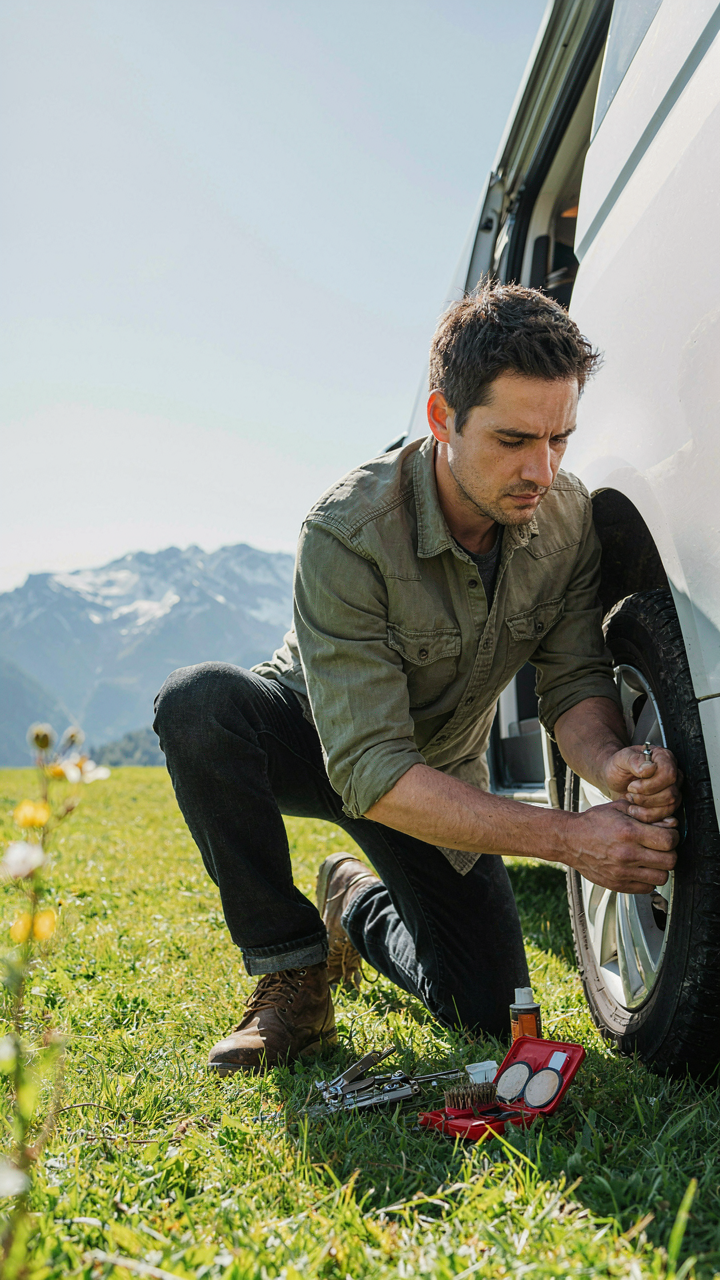
You want to pack light and feel capable, not stranded. The real mechanism here is this: competence replaces cargo. You don’t need a 40-pound toolbox if you understand the three systems that actually fail on vans: water lines, electrical connections, and tire issues. Learn to diagnose a blown water seal, reseat a battery terminal, and patch a tire sidewall. These aren’t optional skills you’ll “get to someday.” They’re the difference between a minor inconvenience and a thousand-dollar tow.
Most people pack redundant gear instead of learning repair fundamentals. You’ll see vans loaded with backup generators, spare pumps, and tools they can’t use. The efficient approach: pack one quality multi-tool, one compact tire repair kit, and basic fittings that match your van’s plumbing. Then spend two hours before departure watching videos on your specific van model and running through each system manually. This costs nothing and eliminates the dead weight of “just in case” items that create false security.
The Phone Is The Problem, Not The Solution
Digital minimalism isn’t about aesthetics or Instagram optics. It’s about cognitive load, which engineers measure as the number of decision points your brain processes per hour. You arrive at a campsite and your phone immediately demands attention: notifications, maps, social media, work emails. This fragments your focus and makes van life feel like a compressed version of your normal life, not an escape from it. The mechanism is simple: every app running in the background drains mental energy before you do anything physical.
Pack your phone. Leave the charging cable and power bank in the van. Set it to airplane mode except for the 30 minutes each evening when you deliberately check messages and plan the next day. Download maps offline before leaving cellular range. This isn’t deprivation, it’s architecture. You’re removing the option to fracture your attention, which makes presence the path of least resistance. Most people underestimate how much their mental clarity improves when they’re not one notification away from distraction.
The Van Life Checklist: Prioritizing Experience Over Possessions

Start With What You’ll Actually Do
You want permission to pack less and feel like you’re not sacrificing anything. The real mechanism is simple: most people pack for imaginary scenarios instead of the three or four activities they’ll repeat every trip. Your van has finite space. Your energy for setup is finite. The activities you repeat define what stays in the van and what gets left behind.
Start by listing the core activities you’ll do on this trip. Not the aspirational ones. The ones you know you’ll repeat. If you’re fishing twice a day, pack fishing gear before the hiking boots you might use once. If you’re cooking elaborate meals, prioritize kitchen space over a folding table. Activity frequency, not activity appeal, determines what deserves real estate in your van.
Pack For The Stories You’ll Keep
The common advice here is wrong: “pack for comfort” or “pack for safety.” You don’t actually care about either one at the granular level. You care about doing the activities that create memories, then being comfortable enough to do them again tomorrow without injury. That’s different.
A good camera takes precedence over a backup camera. A quality sleeping pad matters because it determines whether you wake refreshed enough to hike at dawn. Your portable speaker gets packed because the moment you’ll remember is sitting around a fire with people, not the moment you solved a logistical problem. Pack to enable repetition of what you’ll actually do, not to eliminate all possible discomfort. The mechanism is this: on your last day, you won’t remember what you brought. You’ll remember what you did.
Campervan Travel Essentials Checklist: Applying Economic Principles

Every Item Costs You Something Else
You want to pack everything because you’re afraid of being unprepared. That’s the real anxiety driving most packing decisions. But economics names the mechanism: opportunity cost. Every pound you add to your van reduces payload capacity, fuel efficiency, and maneuverability. Choosing a cast iron skillet means you can’t fit a second water container. That’s not a small trade-off in remote camping.
The math is brutal and simple. Most vans have payload limits between 1,000 and 1,500 pounds after accounting for fuel, water, and body weight. Every duplicate item, every backup tool, every “just in case” gadget eats into that ceiling. You don’t choose between packing a tent or not packing a tent. You choose between a tent and fresh water storage, or between a propane heater and cooking equipment. Name the trade-off explicitly before you pack it.
The Point Where More Gear Breaks Down
Most advice tells you to pack backup versions of critical items. That’s incomplete. Diminishing returns kicks in fast with gear redundancy. The first backup knife adds real safety value. The third backup knife adds almost nothing while consuming space, weight, and mental overhead. You reach a threshold where additional gear stops solving problems and starts creating them: harder van organization, longer setup times, decision paralysis about which tool to use.
Test this principle empirically on your first trip. Bring what feels like a full loadout, then track which items you actually use. Most people discover they use roughly 20 percent of what they packed. On subsequent trips, cut your gear count by 30 percent and track your satisfaction level. The diminishing returns curve flattens faster than you think. Build your packing list around items with proven use, not theoretical scenarios.
The Adaptive Loadout: Van Packing Tips From Military Strategy
Build Your Gear Into Modules
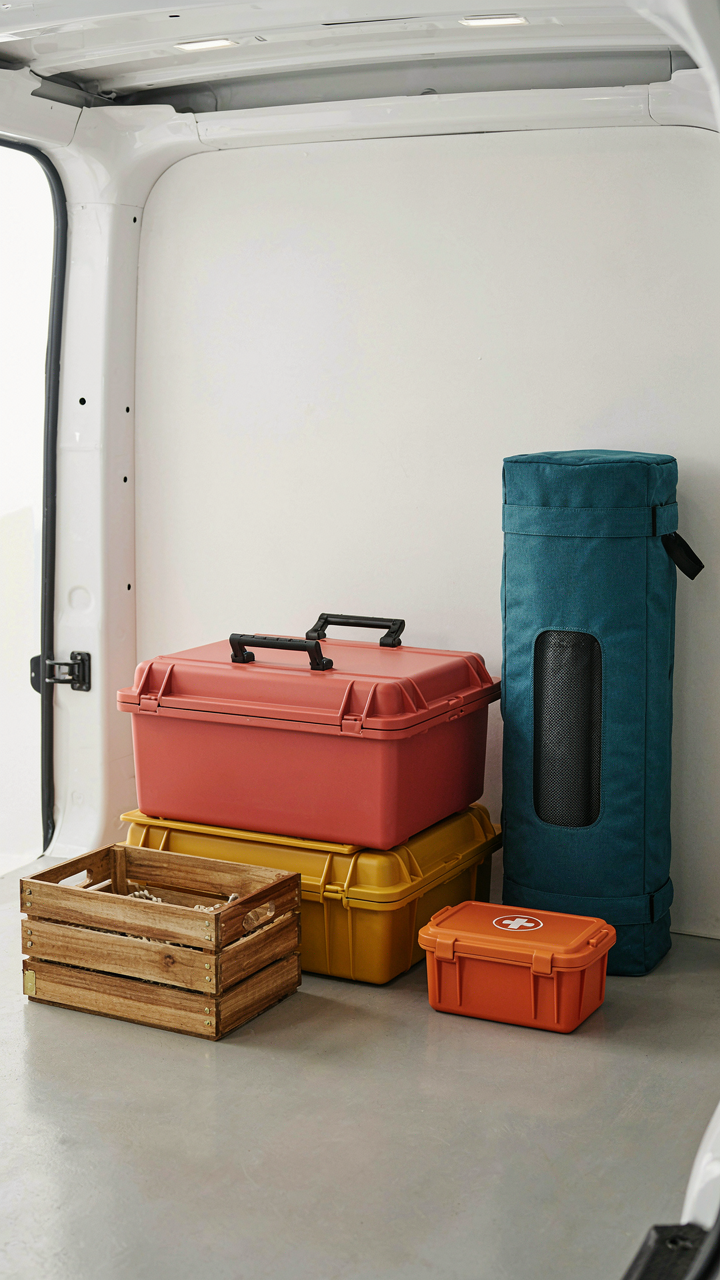
You want to feel prepared without carrying dead weight. Military logistics borrowed the concept of modularity from systems design: breaking one large system into smaller, self-contained units that perform specific functions independently. Apply this to van packing by grouping gear into functional modules rather than packing by category or room.
- Cooking Module: Stove, fuel, utensils, lightweight pots, and seasoning containers in one designated bag or bin. Grab it once, deploy it complete.
- Sleep System: Sleeping bag, pad, and pillow stored together. No hunting through compartments at night or when weather turns.
- Water Management: Containers, filters, and treatment supplies bundled as one unit. Prevents the chaos of hunting for a single component when thirsty.
- Tool Kit: Wrenches, screwdrivers, tape, and basic repair supplies in a single compact case. Address mechanical issues without unpacking the entire van.
- First Aid and Hygiene: Medical supplies, toiletries, and personal care items grouped together for quick access during emergencies or routine needs.
- Clothing Capsule: Outfits organized by temperature range or activity type, not scattered across multiple bags. Reduces decision friction and saves space.
Modularity forces you to pre-think your van’s function. You load modules only for the trip duration and climate. A weekend desert run requires different modules than a two-week mountain stint. This approach eliminates the default behavior of overpacking because you physically see what each module contains and commit to its necessity before departure.
Backup Only What Breaks Your Trip
Most packing guides tell you to bring backups of everything. That’s nonsense and contradicts how van life actually works. The mechanism here is constraint thinking: resources are finite, so redundancy must target only systems where failure derails the entire trip.
Your sleeping system fails and the trip ends. Your cooking stove fails and you still eat, just not your preferred meals. A backup sleeping pad costs weight and space for a problem that won’t kill the trip. A backup water filter actually might, depending on your route and water sources. Backup socks? Your original pair dries. Backup tent? You have the van. Backup starter motor? You’re stranded. The distinction separates what you redundantly carry from what you don’t. Identify only the three to five systems where failure forces you home early: water acquisition, navigation, shelter in extreme weather, and vehicle operation. Backup those specifically. Everything else follows standard packing logic where one quality item, properly maintained, suffices for a normal trip duration.
Van Life Essentials List: Power, Water, And Waste The Unsexy Truths

Your Power Budget Is Your Real Constraint
You want to believe van life means unlimited freedom. It doesn’t. Your actual constraint is watts, not miles. Most people pack electronics first and power second, which is backwards. Think of your electrical system like economics: you have income (solar, alternator, shore power), expenses (fridge, lights, devices), and debt (battery depletion). You can’t spend money you don’t have. Calculate your daily amp-hour draw before you buy a single item. Refrigeration eats 30-60 amps per day. Laptops pull 5-15 amps per charge. That 2000-watt inverter means nothing if your battery bank can’t feed it.
Most vans run 100-200 amp-hour lithium or 200-400 amp-hour lead-acid systems. Cheap advice says “get solar panels.” That’s incomplete. A 400-watt solar array generates maybe 80-120 usable amps on a good day, and that’s before cloud cover, dust, and angle inefficiency. You need the math: daily draw plus cloudy-day reserves plus charge time. Pack what your system can actually support, not what you want to support. The mechanism is simple: overdraw and you’re camping without power, period.
Disposal Systems Determine Your Range
Most van lifers talk about water tanks and ignore waste. Wrong priority. Your freshwater range matters less than your greywater and blackwater capacity because dumping waste limits where you can park. Greywater (sinks, shower) fills faster than freshwater drains. Blackwater (toilet) sits in a tank that needs professional disposal. A typical van carries 40-60 gallons fresh, 40-80 gallons grey, and 20-30 gallons black. You can boondock three days on water. You can boondock ten days on greywater capacity.
The unsexy truth: your waste system determines your actual freedom, not your power system. A portable toilet or cassette system lets you park anywhere legal. A full plumbing setup with tanks locks you to dump stations every 5-7 days. Choose your waste strategy first, then build water capacity around it. If you want true remote camping, a 5-gallon greywater tank and 20-liter portable toilet beat a 100-gallon grey tank every time. You move more often but you move where you want. Dump stations cluster near towns. Your range expands when you stop waiting for infrastructure.
The Unpacking: What Van Life Really Demands

Stop Treating Packing As Shopping
You’re hoping a perfect gear list will make van life feel safe and manageable. It won’t. The real mechanism at work here is the shift from consumer logic to creator logic. Consumers accumulate objects to fill perceived gaps. Creators accumulate only what produces an output. In van life, every item either generates work, enables rest, or solves a specific constraint. Nothing else belongs. Most packing guides miss this because they’re written by gear reviewers, not people who’ve actually lived in 120 square feet for months.
The moment you stop asking “what might I need” and start asking “what am I actually building here,” your pack shrinks by half. Your van isn’t a mobile apartment designed for comfort. It’s a production base designed for output. A writer needs a laptop and notebook. A photographer needs lenses and a tripod. A remote worker needs power and connectivity. Everything else is drift. Pack for your function first, your survival second, your comfort third. The hierarchy matters because space is the constraint that forces honest prioritization.
Friction Becomes Your Teacher
Discomfort in van life works like progressive overload in strength training. Your body adapts by building capacity, not by increasing comfort. The common advice says “pack extra blankets and pillows to feel at home.” That’s backwards. Insufficient sleep won’t kill you, but it will force you to solve your thermal problem or optimize your sleep setup instead of ignoring it. The real growth happens when you can’t avoid the problem. That’s when you engineer a better solution.
Strip your comfort items deliberately. A single lightweight blanket instead of three heavy ones. One pillow instead of two. Cold showers instead of hot water on demand. Each friction point teaches you something: where you actually need investment, where you’re just chasing habits, where your tolerance is higher than you thought. Pack only what’s required to function, then add one item per category as you learn what actually matters. That method replaces guessing with data.
The Real Obstacle Isn’t What To Pack; It’s Your Addiction To External Validation And The Illusion Of Preparedness

You don’t need a perfect packing list. You need to stop waiting for one. Most people never leave because they’re still researching, still optimizing, still convinced the next article holds the missing piece. Pack what you own today, get in the van, and learn what actually matters through friction. Your first trip will teach you more than ten guides ever will. Stop preparing for the trip you imagine and start taking the trip that’s real.