

The “Annapurna Circuit” Fallacy: Your Bucket List Isn’t A Plan

Generic Lists Break Down On Day Three
You want to tell people you did something hard—that’s the real currency here, not the trek itself. The problem: most people plan by copying a famous route, reading five blog posts about it, and assuming their body and mind will cooperate with the consensus itinerary. This is wishful thinking dressed as preparation. Generic lists (distance per day, elevation gain, “best season”) ignore the actual variable that determines success: the gap between your current capacity and the route’s demands.
Your fitness level, altitude tolerance, injury history, and mental resilience don’t exist on anybody’s published itinerary. When you follow a standard Annapurna Circuit guide that says “Day 4: 16km to Manang,” you’re borrowing someone else’s pace. That person trained differently, sleeps differently, and doesn’t have your creaky left knee. The route doesn’t adapt. You do—or you suffer and quit.
The Actual Choice You’re Making

Personalized challenge and curated experience are not the same thing, and you must pick one. A curated experience means you’ve selected a trek, looked at photos, read the reviews, booked lodges, and accepted the standard route structure. You’re consuming a product. Personalized challenge means you’ve audited your own limits, designed a route that meets you where you are, and built progression into the plan so capacity grows with distance.
Most people want both and end up with neither. They get the curated route (so no real choice), experience real suffering (because it wasn’t personalized), and call it character-building. The mechanism is simple: write down your longest hike to date, your current weekly walking distance, and any injury or altitude history. Then find or design a route that starts 20 percent below that baseline and climbs gradually. A plan is not a destination. It’s a series of daily decisions that match your body’s actual response, measured and adjusted in real time.

Beyond Gear: The Psychological Loadout Protocol

Mental Fortitude Is A Nonrenewable Resource
You want to believe that showing up means you’ll finish. That’s the trap. Mental fortitude isn’t something you summon on day three when your legs fail and the weather turns. It’s a finite resource you deplete through poor decisions before the trek even starts. The mechanism is simple: every small choice to avoid discomfort now—skipping the training run, not testing your gear in rain, glossing over the route—you’re withdrawing from an account you’ll need to draw from later.
Experienced trekkers don’t talk about willpower because they’ve already converted it into system design. They train not to be tough but to reduce the number of decisions their mind has to make under stress. When your body breaks down mile eight of day four, your brain needs oxygen for survival, not motivation. The practical step: identify the three hardest moments you’ll face on your trek, then spend one training session living through each one deliberately. Not thinking about them. Physically experiencing them.
Pre Visualize The Breakdown, Not The Summit
Everyone visualizes the finish line. Almost nobody visualizes the 2 PM wall on day two when the route gets steep, your pack weighs more than it should, and you have eight miles left before camp. Military training frameworks call this stress inoculation: you rehearse failure conditions so the actual event registers as familiar instead of shocking. Your nervous system doesn’t distinguish between real and vividly imagined experience at the neurochemical level.
Build a failure scenario for each day of your trek. What goes wrong on day one? Blisters. Day two? Fatigue and doubt. Day three? Both, plus weather. Close your eyes and feel the exact moment you want to quit. Don’t inspire yourself. Don’t think about why you’re doing this. Just sit with the discomfort until it becomes mundane. The night before you depart, you should feel like you’ve already lived through the hardest parts. Then the actual trek becomes a confirmation of something you’ve already handled.
The Scarcity Mindset: Engineering Trekking Resilience

Energy Economics On The Trail
You want to believe you’ll push through fatigue on willpower alone. That’s not how the body works. Treat energy as a finite resource with a hard spending limit, and you shift from motivation-based thinking to systems-based thinking. Your body burns calories whether you’re moving or not. A multi-day trek forces a caloric deficit you can’t escape. The mechanism: consume what you need, waste nothing, and ration strategically.
Conventional advice tells you to “pack enough food.” That’s incomplete. You need to calculate your actual burn rate, which depends on terrain gradient, pack weight, altitude, and temperature. A person hiking uphill at elevation burns significantly more than flat terrain. Most trekkers overestimate their reserves and underestimate their consumption. The move is to front-load calories on high-demand days and accept lower intake on easier days. Your energy system works like a bank account: spending more than you deposit forces withdrawal from reserves, which accelerates fatigue and poor decision-making.
Water, Shelter, Warmth In Priority Order
People list these three because they’re baseline survival. But the order you prioritize them matters more than the list itself. In a scarcity scenario, you protect the system that fails fastest first. You can survive weeks without food. You die of dehydration in days. You lose core temperature and lose cognitive function in hours. Water sources determine your route. Shelter and warmth extend your window to recover from mistakes. Build your multi-day plan around reliable water access, then identify shelter options, then verify you can maintain temperature.
The real protocol: Scout your water sources before you leave. Know where you’ll camp by midday, not when you’re exhausted. Bring a lightweight tarp and sleeping system rated 10 degrees below the coldest forecast temperature. These aren’t backup plans. They’re the primary constraints that shape your entire route and schedule. If water is scarce on your chosen trail, you change the trail. If shelter options are nonexistent, you shorten your days or choose different terrain. Scarcity mindset means constraint shapes the plan, not the plan stretches to fit an unrealistic constraint.
Navigation Is Not An App: The Cartography Command

Paper Maps And Compass Mastery
You want the security of knowing you won’t get lost without battery drain or signal. Here’s what nobody says plainly: navigation is a language, and paper maps are grammar. Cartography borrows from military strategy the concept of “terrain domination”—knowing the land before you move through it. A paper map forces you to read the entire landscape, not just the blue dot on a screen. You see elevation change, water sources, ridgelines, and escape routes all at once. This is pattern recognition, not location tracking.
Most trekkers treat compass skills like a backup plan they’ll never use. Wrong. A compass is how you orient a map to reality, confirm your position without power, and move at night or in fog. Learn to take a bearing, identify landmarks, and triangulate your position. These are not nice-to-haves. They’re the foundation. Practice on day hikes first. Your paper map should show contours in detail, not just trails. Mark water sources, camps, and alternate routes before you leave. Study the map until the terrain becomes familiar.
GPS As Backup, Not Primary
The mechanism here is dependency. GPS lulls you into outsourcing navigation decisions to a device. You stop reading terrain and start reading a screen. Batteries die. Screens fog. Signals drop in canyons and dense forest. A GPS unit is insurance, not navigation. Carry one, but use it only to verify position, confirm you’re on route after mistakes, or navigate in genuine whiteout conditions.
Train your navigation skills on paper and compass. Load a GPS device only as a secondary checkpoint. Take bearings manually. Identify landmarks. Walk the map before you walk the trail. When you reach a GPS decision point, you’ve already solved it two other ways. This redundancy saves lives when conditions deteriorate. Your protocol: navigate by map and compass first, confirm with GPS second, never lead with the device.
Risk Assessment: Beyond The Hiking Checklist

Environmental Threats And Your Actual Exposure
You want this section because you’re afraid of looking unprepared, not because you’re actually afraid of dying. That distinction matters because most trekkers overweight gear-based solutions and ignore behavioral exposure. Borrowing from systems engineering, you need to map your “failure modes” to the specific terrain and season you’re entering. A rockfall hazard on a alpine pass demands different mitigation than exposure to hypothermia in a wet forest. Environment dictates threat profile. Know your route’s elevation band, weather pattern, and geology before you plan defenses.
Altitude sickness, water contamination, and exposure kill more trekkers than equipment failure. The generic advice says “bring a first aid kit.” That’s lazy. What actually matters: knowing whether your route demands descent capability for AMS, whether water sources require chemical treatment or just filtration, and whether your clothing system handles the recorded temperature extremes for that month and elevation. Research your specific trek’s documented incidents. Call local guides. Run scenarios. The mechanism is simple: threats become manageable once you stop treating them generically.
Communication When Help Is Hours Away
Most trekkers carry a satellite messenger and feel protected. That’s wrong. The tool matters less than your decision protocol around when to activate it. Military doctrine calls this “escalation of commitment”—the tendency to throw resources at a problem too late. Your emergency communication strategy fails the moment you confuse having a device with having a decision rule. Define now: what physical symptoms or conditions trigger a call for help, who initiates that call, and what you’ll communicate. Write it down. Practice it on shorter treks.
Satellite messengers have failure rates in specific terrain types—deep canyons, dense forest, high latitude valleys. Know your device’s limitations for your route. Better: establish checkpoint protocols with a contact at home who knows your daily hiking plan and camp locations. If you miss a scheduled check-in, they escalate. This removes emotion from the decision-making moment. Your protocol activates automatically, not when panic takes over. Build the trigger, not the hope.
The Logistics Of Self Sufficiency: How To Plan

Mapping Your Food And Water Strategy
You want to believe you can wing this part and still look competent. The truth is simpler: resupply logistics determine whether you finish or turn back. Think like a supply chain manager, not a camper. Your trek is a series of nodes—each resupply point is a checkpoint where you either gain capacity or lose time. Map every known water source and food cache location before you move. Miss one, and you’re calculating rations mid-hike instead of executing a plan.
Water resupply points are non-negotiable anchors. Identify them on your route using topographic maps, guidebooks, and local knowledge. Never assume a stream exists where a map shows it. Verify by contacting recent hikers or locals. For food, you have two options: carry everything from the start, or establish cache points at known locations before departure. Caching works when you have a support person, mule service, or pre-positioned supplies at established trailheads. Without this, you carry your calories. The math is brutal: a trekker burns 5,000 to 7,000 calories daily. That’s roughly two to three pounds of food per day. A ten-day trek demands twenty to thirty pounds of food weight. This is not optional weight. Plan your resupply rhythm before the trek, not during it.
Leave No Trace Waste Protocol
Most guidance here is vague guilt wrapped in ideology. What you actually need is a mechanical system that works whether you care about the environment or not. Waste management on multi-day treks operates under one constraint: you cannot leave anything behind that degrades the site for the next person. That includes human waste, which is the real problem nobody names directly. Carry a portable waste kit. The system is straightforward: solid waste goes in sealed bags, human waste goes in a cathole dug two hundred feet from water sources, and that cathole gets filled and marked.
Liquid waste and greywater follow the same distance rule. Pack out all food scraps, foil, and packaging. Burn nothing except paper if fires are permitted. Your pack weight increases by two to three pounds for waste containment and packing materials. This is the cost of the system. Use biodegradable soap if washing, and scatter greywater at least two hundred feet from water sources. The discipline here is not moral. It’s operational. Each trekker who fails to follow this protocol increases the likelihood that trailheads close, regulated trek zones shrink, and your future access disappears. Execute the protocol because it keeps the resource viable for your next trek.
Physical Conditioning: Not Just A Day Hike
Build Strength Where Terrain Demands It
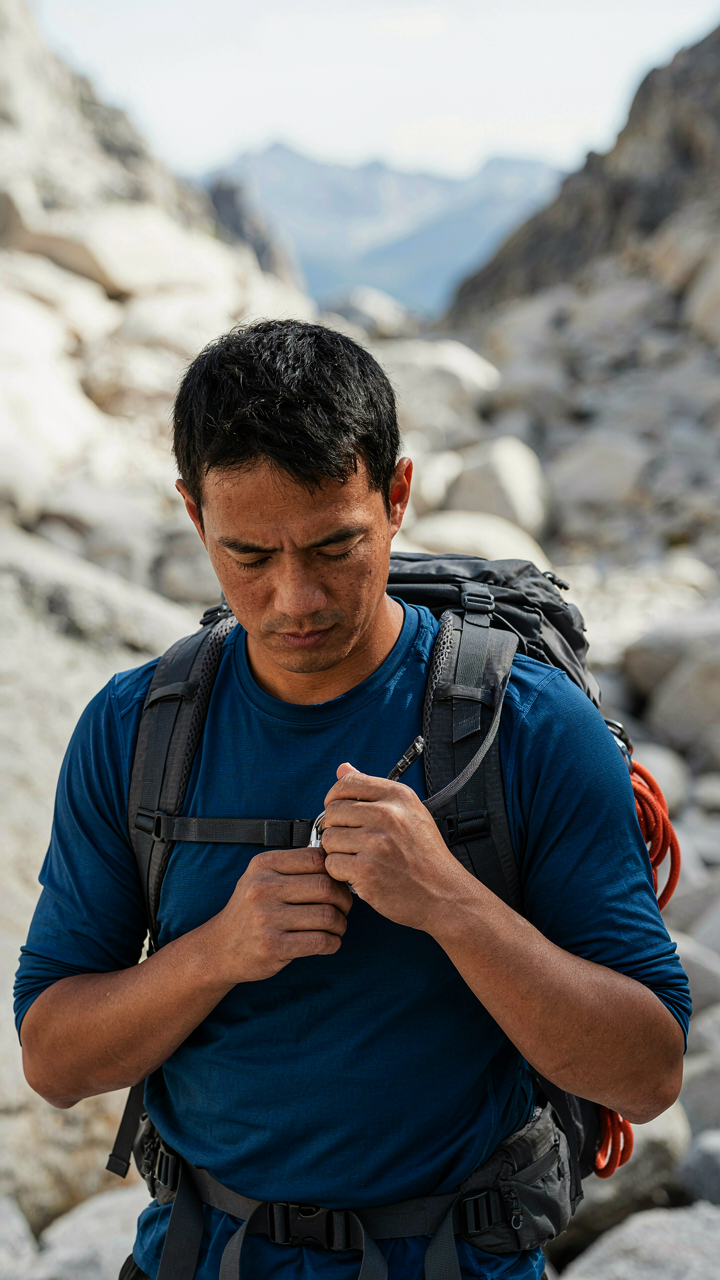
You think you need to look fit for this. What you actually need is to move heavy loads uphill without your knees collapsing on day four. Biomechanics from sports science identifies load capacity as the constraint: your body’s ability to absorb and distribute force under sustained weight. A day hike trains you to move yourself. A multi-day trek trains you to move yourself plus thirty pounds of gear for six hours straight, repeatedly, on consecutive days.
Strength work targets the specific muscles that fail first: quads, glutes, and hip stabilizers. Uphill hiking hammers the quad eccentrically, meaning it lengthens under tension as you descend. Most people skip eccentric training and then wonder why their knees hurt going downhill on day two. Heavy back squats and Bulgarian split squats build the eccentric tolerance you need. Start this work eight to twelve weeks before your trek. Three sessions per week, moderate to heavy load, low reps. Stop when form breaks. This is not about endurance circuits or feeling the burn.
Hiking With Added Weight
Pack weight training separates those who finish comfortably from those who suffer. The mechanism is adaptation: your body recruits different stabilizer muscles and neural pathways when loaded versus unloaded. Training without weight teaches your body one pattern. Training with weight teaches it another. You need the latter.
Start with a weighted pack at thirty to forty percent of your target trek load. If you’re carrying forty pounds on the trek, train with twelve to sixteen pounds first. Take this weight on your regular hiking routes, starting with easy terrain and flat ground. Add five pounds every two weeks until you reach your goal weight. Do this for at least four weeks before departure. Train on varied terrain in the final two weeks: hills, descents, uneven ground. Your ankle stabilizers, core, and proprioceptive system adapt to the specific demands of loaded movement. Stop treating conditioning as separate from trek simulation.
Post Trek Debrief: The Unsung Element Of Hiking Tips

What Actually Went Wrong
You skip this step because admitting failure feels like wasted energy, but the mechanism is simple: your brain defaults to remembering the highlight reel, not the breakdown points. Use the same rigor you’d apply to a failed business decision. Within 48 hours, write down three specific failures: where your pace estimate missed, where gear underperformed, where navigation cost you time. Not vague feelings. Concrete moments with timestamps and conditions.
The gap between what you planned and what happened is the only data that matters. Most hikers feel good about finishing and call it a win, missing the actual breakdown that will repeat on the next trek. Blisters at mile 14 aren’t random. Dehydration on the second day isn’t bad luck. They’re systematic failures in your decision-making or preparation. Document them while the conditions are still clear in your memory.
Building Systems From Failure
Borrowing from engineering, treat each failure as a stress point that revealed a design flaw in your system, not an anomaly. A navigation error didn’t happen because you got unlucky; it happened because your map-reading protocol was insufficient for that terrain type. A food shortage didn’t occur because you miscalculated; it happened because your caloric intake model didn’t account for your actual exertion level. The lesson integrates only when you identify the broken system, not just the symptom.
Take each documented failure and trace it backward to the decision or assumption that created it. Then build a specific protocol to prevent it: a checkpoint verification routine for navigation, a calorie recalibration formula based on elevation gain and temperature, a blister prevention threshold that triggers sock changes. Store these protocols in a single document you review before every trek. The debrief only matters if it changes your next expedition’s setup.
The Real Multi Day Trekking Bucket List: Experience Over Endorsement

Seek Challenges That Test Your Limits
You want the trek that makes people ask questions, not the one that gets likes. The mechanism is simple: routes chosen for their social currency trap you in someone else’s narrative instead of building competence. A trek matters when it demands something from you that you didn’t know you could provide.
Popular routes are popular because they’re accessible, not because they’re meaningful. The Inca Trail gets forty thousand trekkers yearly. That density strips the experience of solitude and forces you into manufactured choreography. Choose a route that scares you slightly more than it appeals to you. Fear signals growth. Appeal signals comfort.
Build Capability, Not Dependency
Manufactured adventure is what outfitting companies sell you. Self-reliance is what you build by planning routes where you navigate terrain decisions, manage water sources, and execute camp setup without a guide script. The military term is “commander’s intent”—knowing your objective so thoroughly that you adapt when conditions shift instead of following rigid procedure.
Most trekkers treat guides as insurance against mistakes. Real trekking uses guides as accelerators for knowledge. Request they teach you navigation, weather reading, and site selection instead of just moving you forward. Before your next trek, practice map reading and compass navigation in local terrain for two months. Your decision-making speed during the trek depends on this baseline skill. Without it, you’re dependent. With it, you’re operational.
The Real Obstacle Isn’t The Trail, It’s Your Refusal To Embrace Discomfort And Strategic Scarcity

Most people don’t fail at multi day trek planning. They fail at committing to the discomfort it requires. You’ll spend weeks obsessing over gear weight while avoiding the actual decision to go. Stop researching and book your dates today. The planning becomes clear once you remove the escape hatch. Your body adapts faster than your excuses multiply.