

The International Travel Paradox: Why “Easy” Kills Growth

Comfort Breeds Complacency, Not Adventure
You want the destination that won’t stress you out because you think stress kills the experience. It doesn’t. Stress creates memory. The mechanism here borrows from biology: hormonal response to novelty. Your brain doesn’t encode ease as significant. It encodes friction. Thailand offers no friction for first-timers—airport assistance, English speakers, tourist infrastructure everywhere. Your brain files it away as consumed content, not lived experience. You follow the path ten thousand travelers walked before you and return with the same story everyone tells.
The destinations that rewire you are the ones that force decision-making in real time. When you navigate a language barrier, negotiate a price, or recover from a missed connection without a backup plan, your nervous system activates. That activation is learning. It’s not comfort. It’s the opposite of comfort. And that’s precisely why it sticks. Discomfort is the tax you pay for an actual story.
The Generic Experience Trap

Everyone tells you to avoid challenge on a first trip. Bad advice. Avoiding challenge guarantees you’ll visit the same curated Instagram locations as three million other travelers and return home with photos that prove you were there, not evidence that you lived there. First-timers mistake safety for easiness and easiness for value. They don’t correlate.
The real move is choosing destinations where the baseline difficulty is moderate, not zero. Colombia, Vietnam before the tourist boom, Portugal off-season, Mexico City outside the resort zones. Places where infrastructure exists but doesn’t hold your hand. Your job isn’t to find the softest landing. Your job is to find the place where you’ll be forced to interact with locals, make decisions without a guidebook, and actually solve problems. That’s where the growth happens. Choose a destination that requires you to develop one new skill before you arrive.

First International Trip: The Immersion Imperative

Places That Demand You Show Up
You want the destination to feel safe enough that you don’t bail out, but foreign enough that coasting isn’t an option. That’s the real tension. Neuroscience calls this optimal arousal: stress high enough to force neuroplasticity, low enough to prevent shutdown. The best first destinations operate at this threshold. They force decisions. You navigate unfamiliar streets. You order food without a picture menu. You sit in a room where nobody speaks your language and figure out how to communicate or go hungry. Safety nets exist, but you can’t hide in them.
Thailand, Vietnam, and Mexico sit in this zone precisely because infrastructure supports independence without eliminating friction. You can get lost and get found again. You can fail small and learn fast. This isn’t about checking boxes at tourist sites. It’s about being placed in situations where passivity costs you something real: a meal, directions, a conversation. That cost is the mechanism that rewires your brain. Comfort destinations don’t build this. They build photo albums.
The Friction That Actually Works
Everyone says find authentic experiences. Nobody says why that matters beyond sounding cultured. The mechanism is exposure to decision-making outside your default context. When you sit in a market haggling over prices, you’re not sightseeing. You’re operating under different rules. You negotiate. You compromise. You learn that your first instinct doesn’t always work. Bali resorts where staff anticipate every need give you nothing. Markets, street food stalls, and local buses give you everything.
Destinations like Peru, Colombia, and Indonesia place you in environments where locals don’t cater to tourists as a primary function. You’re adjacent to daily life, not centered in it. You take buses with commuters, eat where families eat, get directed by people who aren’t paid to help you. The discomfort resets your baseline for what normal is. When you return home, your tolerance for complexity expands. Your ability to navigate ambiguity becomes your actual skill, not your travel photos. This is why you go. Build trips around this principle: choose places where tourism is supplementary, not the economy.
The “Scarcity Mindset” Of Countries To Visit

Overplanning Kills More Trips Than Bad Timing
You’re afraid you’ll miss something. That fear drives the obsessive planning, the spreadsheets, the 47-tab browser windows. Here’s the mechanism: scarcity thinking from economics applies directly to travel. When you believe destinations are finite and time is running out, you optimize for completion instead of experience. You build an itinerary so dense it becomes a checklist you resent by day three. The best first trips aren’t planned—they’re structured just enough to move, then loose enough to wander.
Thailand works for first-timers partly because its infrastructure forces this balance. You can’t see everything in two weeks, so you stop trying. You pick a region. You move slower. You notice the street vendor’s routine instead of sprinting to the next Instagram spot. The trap isn’t underplanning—it’s the false belief that randomness equals waste. Random doesn’t mean directionless. It means you booked flights and accommodation, but you’re open to the coffee shop conversation that changes your route.
The Myth Of Seeing Everything In One Trip
The common advice says you should “experience the culture” and “see the highlights.” That’s incomplete. You can’t compress a country into a trip. Portugal takes most people three to five visits before they stop moving like tourists. Mexico’s complexity requires repeat exposure. First-time travelers who try to hit seven cities in ten days don’t remember destinations—they remember airports and exhaustion.
Narrow your geography instead. Pick one region in one country. Spend real time. You’ll see more by staying put than by checking boxes. Barcelona for two weeks beats Barcelona, Madrid, and Lisbon in three weeks. A first trip isn’t about maximum coverage. It’s about finding what travel feels like to you without the motion sickness. This sets your actual preferences before you plan trip two.
The Anti Tourist Protocol For Best Places To Travel
Local Transport Reveals What Guidebooks Hide
You want to feel like an insider without doing the work. The real mechanism here comes from logistics: in systems theory, constraint mapping shows you where actual activity concentrates. Public transit routes expose the skeleton of a city faster than any curated walking tour. Buses, metros, and shared taxis move residents to work, markets, and homes—not monuments. Ride them without a plan and you see the real infrastructure.
First-time travelers treat transport as a chore between destinations. Wrong. The commute is the destination. In Bangkok, the BTS Skytrain connects residential neighborhoods where locals eat and shop. In Istanbul, the ferry across the Golden Horn moves ordinary people daily, not tourists seeking photo moments. Spending two hours on a local minibus in Morocco teaches you more about regional hierarchy, commerce, and daily rhythm than a guided tour ever will. Sit, observe, absorb the pattern.
Eat Where Money Changes Hands Constantly
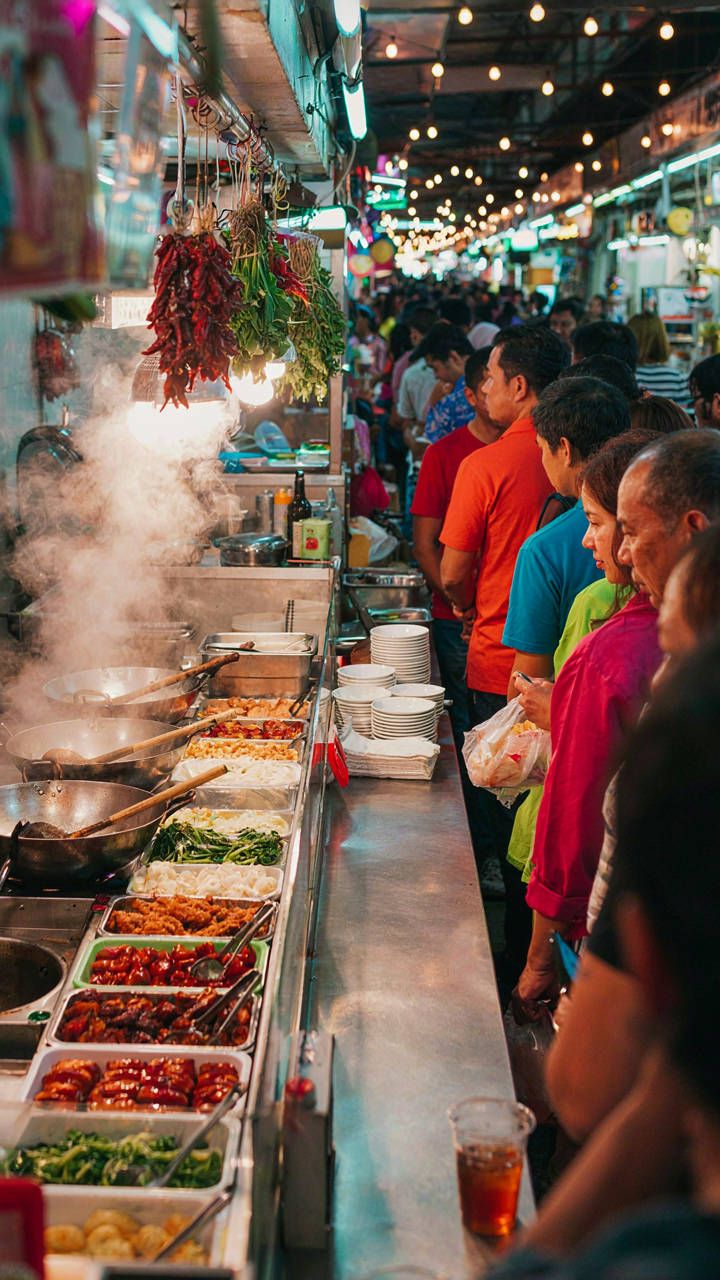
Michelin stars reward restaurants that please critics with capital. Food markets reward restaurants that move volume because locals depend on them. A market stall in Hanoi’s Old Quarter, a mercado in Mexico City, a souk in Marrakech—these spaces operate on pure efficiency. The vendor who survives doesn’t cater to Instagram. They cater to people who eat there five times a week.
The advantage is immediate and threefold: lower cost, better flavor, and real social proximity. You eat shoulder-to-shoulder with workers, families, and students. Conversation happens naturally. You see what people actually choose when nobody’s watching them perform for strangers. In Bangkok’s Yaowarat market or Singapore’s hawker centers, first-time travelers absorb more about local preference and quality in one meal than a week of restaurant reservations. Pick a stall with the longest line. Order what others order. Pay attention to why.
Southeast Asia Travel: The Chaos Theory Of Exploration

When Plans Collapse, You Start Learning
You want Southeast Asia because you think it makes you interesting. The real mechanism is this: Southeast Asia forces rapid decision-making under incomplete information. In chaos theory, a system’s sensitivity to initial conditions determines its trajectory. Southeast Asia is the initial condition. You arrive with expectations. Reality rewrites them immediately. Tuk-tuk drivers quote prices that don’t match guidebooks. Street food vendors operate from unmarked stalls. Monsoon seasons shift travel plans overnight. This unpredictability isn’t a bug—it’s the feature that builds real travel competence.
The comfort travelers seek in guidebooks and curated itineraries actually prevents adaptation. You memorize what to expect, then feel betrayed when it doesn’t match. Southeast Asia punishes this approach. Thailand, Vietnam, and Cambodia require constant micro-decisions: which neighborhood to explore, which restaurant to enter, which transportation option to trust. These aren’t life-or-death calls, but they train your pattern recognition under uncertainty. First-time travelers who embrace this chaos return with actual skills, not just Instagram photos.
The Skill That Actually Transfers
Evolutionary biology teaches adaptation through mutation and selection. Apply this directly: you are the organism, cultural friction is the selection pressure, and repeated small decisions are the mutations. Southeast Asia delivers relentless friction. Language barriers, unfamiliar food, different social norms, transportation systems that operate on different logic than your home country—each one requires you to adjust your model of how things work. You test assumptions constantly. Some fail. You discard them and move forward.
This adaptation process builds something travel articles never name plainly: your personal decision-making framework under uncertainty. When you’ve navigated a Bangkok night market with zero Thai vocabulary, argued a tuk-tuk fare, and found your way back to your hostel using only mental landmarks, you’ve literally rewired how you process novel situations. That skill compounds. You return home more capable at reading unfamiliar environments, interpreting unclear signals, and executing plans with imperfect information. The mechanism is exposure to enough iterations of “wrong assumption, correct, move on” that your brain learns to stop requiring certainty before acting.
Asia Travel Guide: Navigating Complexity, Not Avoiding It

When You Can’t Default To English
You’re scared you’ll look stupid. That’s why this matters. The mechanism is simple: language barriers force you to communicate with intention instead of assumption. You stop talking and start observing. In Thailand, Vietnam, or Japan, your inability to order coffee by reciting a sentence means you point, gesture, make eye contact. This friction teaches you how people actually connect across difference. It’s not a problem to solve. It’s the mechanism that rewires how you travel.
Most first-time travelers treat language barriers as obstacles to minimize through apps and English speakers. That’s backwards. The constraint is the education. When you can’t rely on language, you develop non-verbal pattern recognition. You read body language. You notice tone. You become attuned to what matters in that culture because you have no choice. This accelerates your learning curve faster than any guidebook.
Respect Operates On Specific Rules, Not Vibes
Cultural respect isn’t intuitive. It follows protocols. In Buddhist-majority countries like Thailand, Cambodia, and Laos, pointing at people or objects with your feet is offensive because the head is considered sacred and the feet profane. In Japan, business card exchange involves specific hand placement and timing. Eating noodles loudly in Japan signals enjoyment. Eating quietly in Thailand signals disrespect. These aren’t suggestions. They’re operating systems.
- Shoe removal indoors: Standard across much of Asia. Remove shoes before entering homes, temples, and some restaurants. Observe what locals do before entering any space.
- Head and feet hierarchy: Never touch someone’s head or point with your feet. Sit with soles of feet pointed away from people, especially monks or elders.
- Photography protocols: Never photograph monks without permission. In temples, dress conservatively. Some sacred spaces prohibit cameras entirely. Ask first.
- Eating customs: Slurping noodles in Japan and Korea shows appreciation. Refusing food once offered is polite. Accept small portions and eat what’s served.
- Greeting conventions: Wai in Thailand, bow in Japan, namaste in Nepal. Match their depth and duration. Don’t initiate handshakes in conservative areas.
The shortcut most travelers use is wrong: assuming politeness translates everywhere. It doesn’t. Research the specific destination’s operating system before arrival. Ask your hotel staff about local taboos on day one. Watch locals interact for 20 minutes before you engage. Respect comes from following the rules of someone else’s world, not from your personal definition of kindness.
International Vacation: The “Deep Work” Travel Method

Single Focus On Cultural Absorption
You want to feel like you’ve actually been somewhere, not just collected passport stamps for your mental resume. The mechanism is simple: attention is a limited resource, and dividing it across ten activities means you understand none of them. Treat your destination like a problem to solve, not a checklist to complete.
Pick one neighborhood, one craft, one daily ritual. Spend five days learning how a specific market operates, how locals navigate it, what they buy and why. This isn’t tourism—it’s fieldwork. You’ll notice patterns that guidebooks miss because you’re staying long enough for the place to stop performing for you. Most travelers scatter their focus and leave with Instagram posts instead of understanding.
Observe Without Editing Your Experience
The second you frame an experience for an audience, you stop experiencing it. You’re performing a version of travel instead of having it. Digital detox here means something specific: no curation, no broadcasting, no performance layer between you and what’s actually happening around you.
Keep a private notebook, not a phone camera roll. Write down conversations, descriptions, questions that emerge. This creates distance from the urge to turn moments into content. You’ll notice your brain shifts. Without the camera filter, you see architectural details, overhear actual dialogue, absorb ambient information that never makes it to social media. By day three, you’re no longer a tourist watching—you’re a participant noticing.
Best International Travel Destinations: The Unseen ROI

What Discomfort Actually Builds
You want proof that travel changed you. You want the story to matter. But the real mechanism isn’t the photos or the memories you’ll forget by next year. It’s the moments when your mental models break and you have to rebuild them on the ground. That’s where growth lives.
Neuroscience calls this cognitive updating. Your brain rewires when it encounters conditions it can’t process with existing frameworks. Thailand forces you to navigate by intuition when GPS fails. Peru puts you in situations where your default problem-solving fails and you adapt. First-time travelers in destinations with friction—language barriers, unfamiliar systems, genuine uncertainty—rewire faster than those who visit countries that mirror home. The struggle isn’t a bug. It’s the entire point.
Your Perspective Changed. Now Measure It.
Most travelers measure the wrong things: countries visited, photos taken, passport stamps collected. Psychology and behavioral science offer a better framework. Identity-relevant change sticks. When you return home holding a different belief about what you’re capable of, about how people live, about what matters, that’s the metric that predicts whether travel actually shaped you.
- Decision speed in uncertainty: Time how long it took you to make calls with incomplete information before travel versus after. Shorter intervals signal real adaptation in your nervous system.
- Assumption rejection rate: Count how many beliefs you actively questioned during the trip. Document which ones you discarded. This number reveals actual cognitive flexibility.
- Discomfort tolerance threshold: Rate situations on a scale before travel and after. Can you sit in ambiguity longer without reaching for familiar solutions or escapes?
- Empathy specificity: Instead of “I understand different cultures now,” identify one specific behavior you saw, judged, then recontextualized. Name the mechanism that shifted your view.
- System fluency transfer: Did skills from navigating a foreign system transfer to problems at home? Evidence of real learning shows up when you solve new problems using frameworks born from travel friction.
The destinations that deliver this aren’t the ones with the best infrastructure or the friendliest tourist boards. They’re the ones that demand you participate in their system instead of remaining an observer. Return home and ask yourself one question: what would I have done differently before this trip? If you have a specific answer, travel worked.
The Real Obstacle Isn’t The Destination; It’s Your Unexamined Expectation Of What Travel Owes You

Most first-time travelers chase Instagram moments instead of experiences. They expect the destination to transform them. It won’t. You transform yourself by showing up with curiosity instead of a checklist. Stop asking “Which destination is best?” Start asking “What do I actually want to learn about myself?” Open Google Maps right now. Pick a city you’ve never considered. Book a flight for three months out. The best destination isn’t the one everyone recommends. It’s the one that scares you enough to go.